There is much whooping with joy chez Dreaming In Stitches this morning.
Courtesy of my new phone, I can now listen to Radio 4 Extra while sewing in the sitting room.
I know, I am very easily pleased, as I often tell my husband.
Little things…
a mingled yarn
There is much whooping with joy chez Dreaming In Stitches this morning.
Courtesy of my new phone, I can now listen to Radio 4 Extra while sewing in the sitting room.
I know, I am very easily pleased, as I often tell my husband.
Little things…
It was half term for my daughters last week and inevitably my normal routine – in as much as you can call what I generally do a routine – went up the proverbial Swanee River.
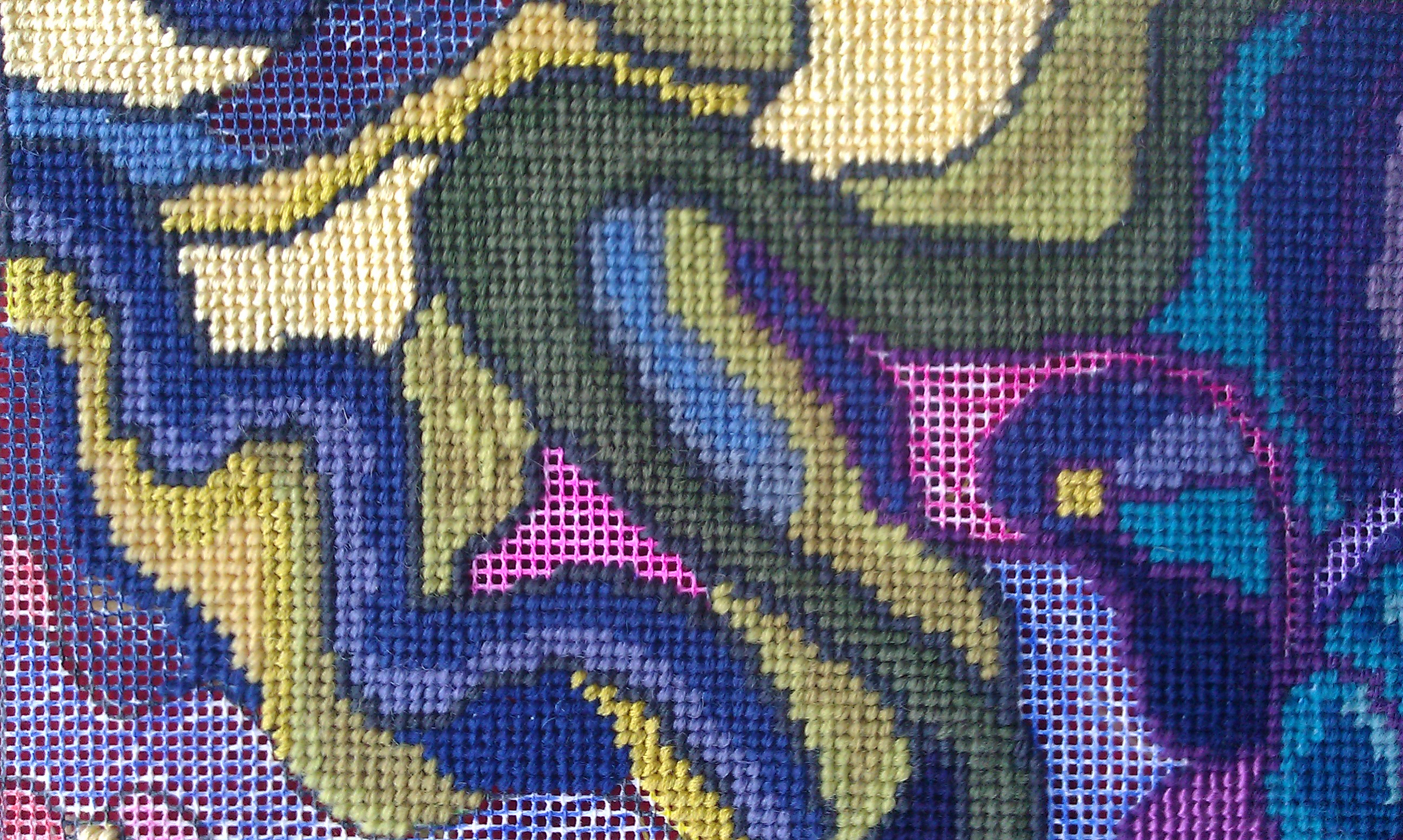
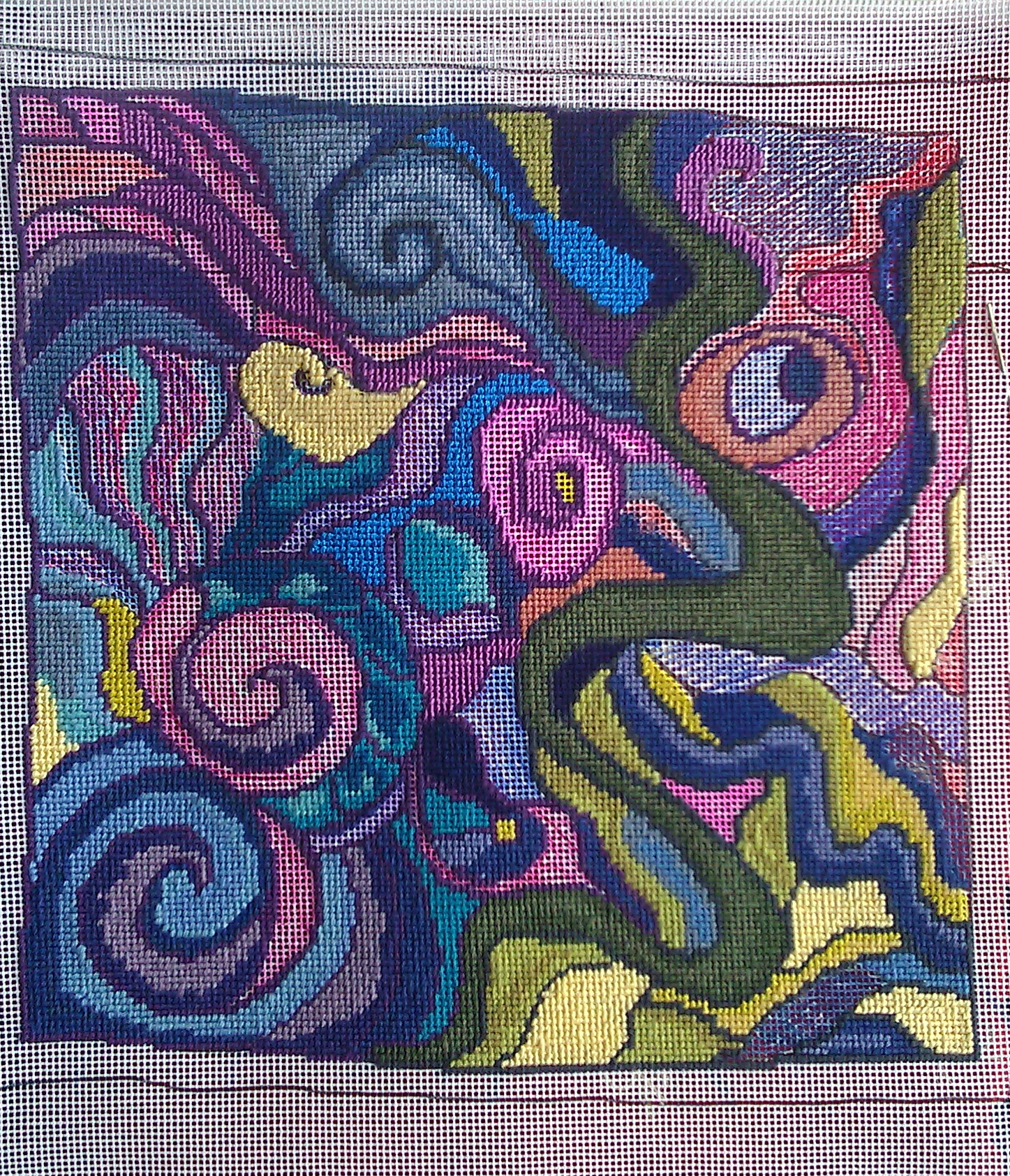
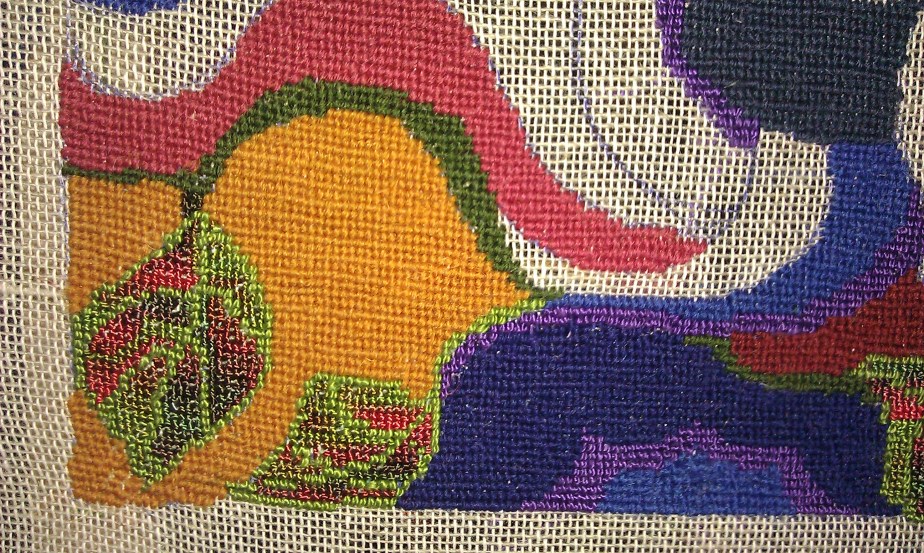
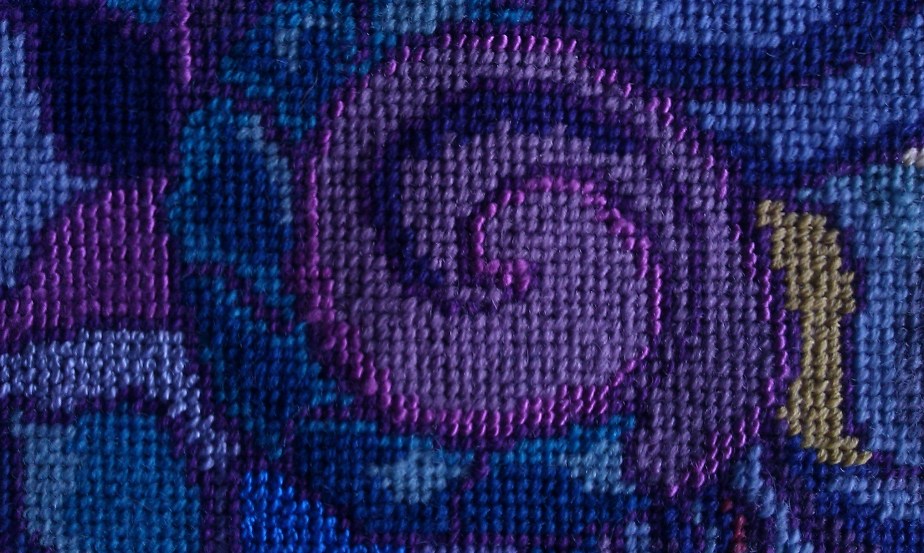
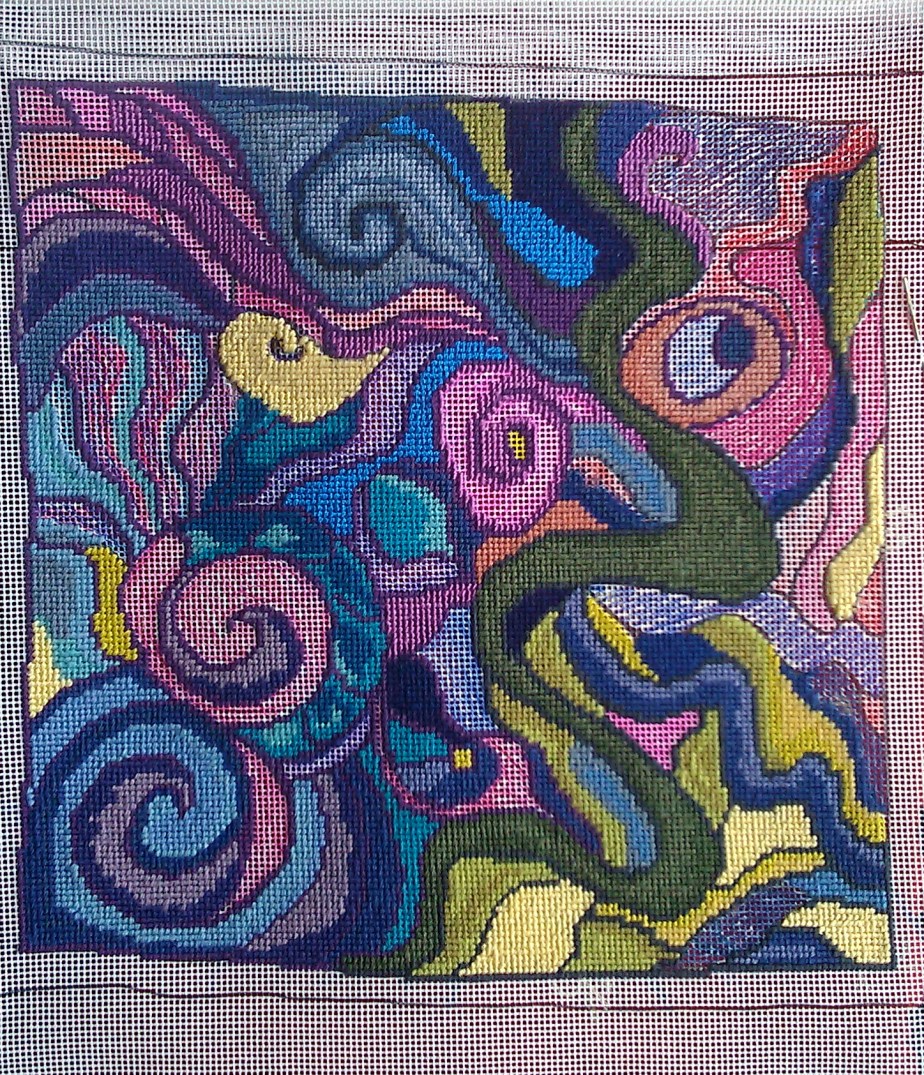
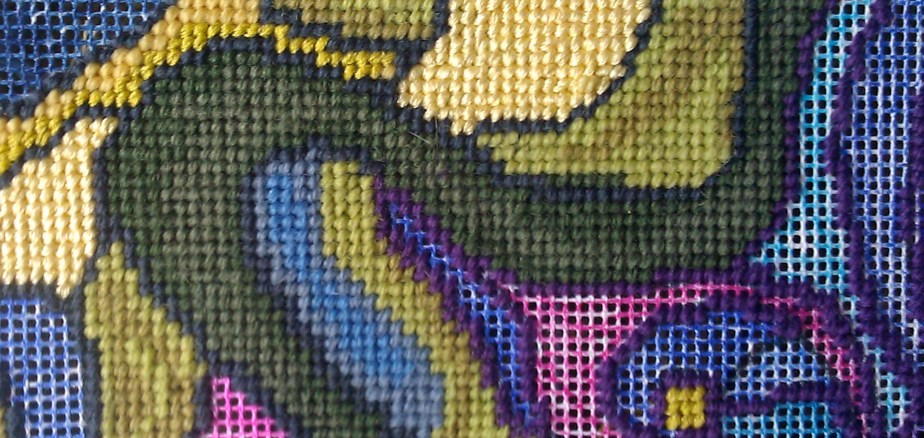
There was some stitching of the Celtic Swirl, but as of this morning this is what it looks like…
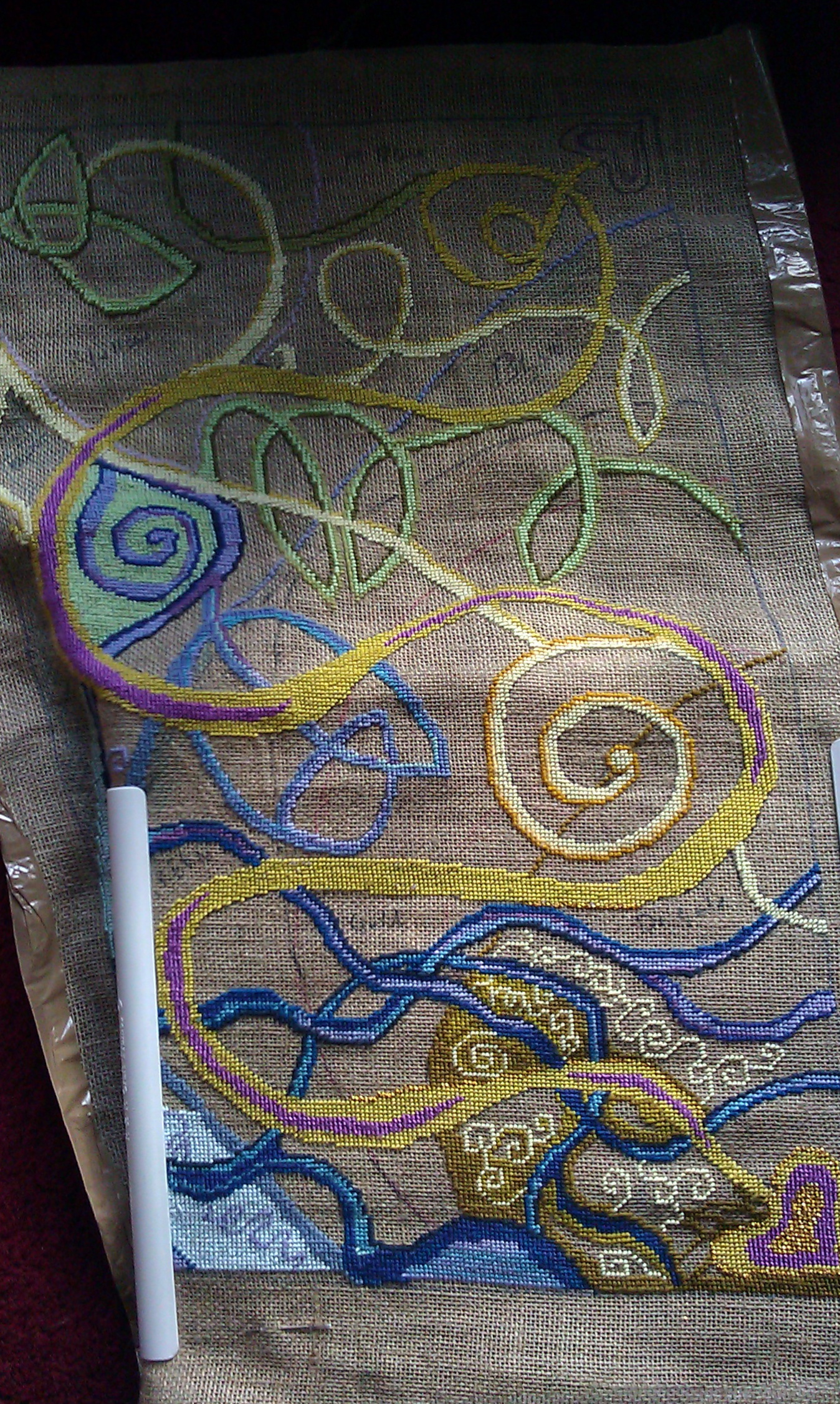
All the ribbons are done – I’m working on the backgrounds. I’m not a fan of huge areas of plain colours, so I’m experimenting with swirls and shading.

I’ve also given in to temptation and included some sparkly gold thread – although it doesn’t photograph well.
I’ve been stitching this morning in the office/dining room/studio/junk room, because I missed huge chunks of the play on Radio 4 extra on Saturday and was determined to hear it properly on iPlayer. The only way I can do that is on the Mac – I really must see if there’s any way to get a comfy chair in here – it just doesn’t feel right, sewing in the office chair.
In typical English fashion, the moment the children go back to school, the sun comes out, but we had a good week, even managing a trip to London, so can’t complain. Now we have the run up to Christmas to contend with – oh joy.
Happy stitching.
It’s impossible to photograph anything here in natural daylight, as someone/thing has turned off the sun – we haven’t seen anything remotely bright in the sky for days now – and I’m getting moderately fed-up with it, arrrgh!
Okay, rant over – ish.
So anyway, (deep breath), moving on, just to say that there is some progress on the Celtic Swirl tapestry.
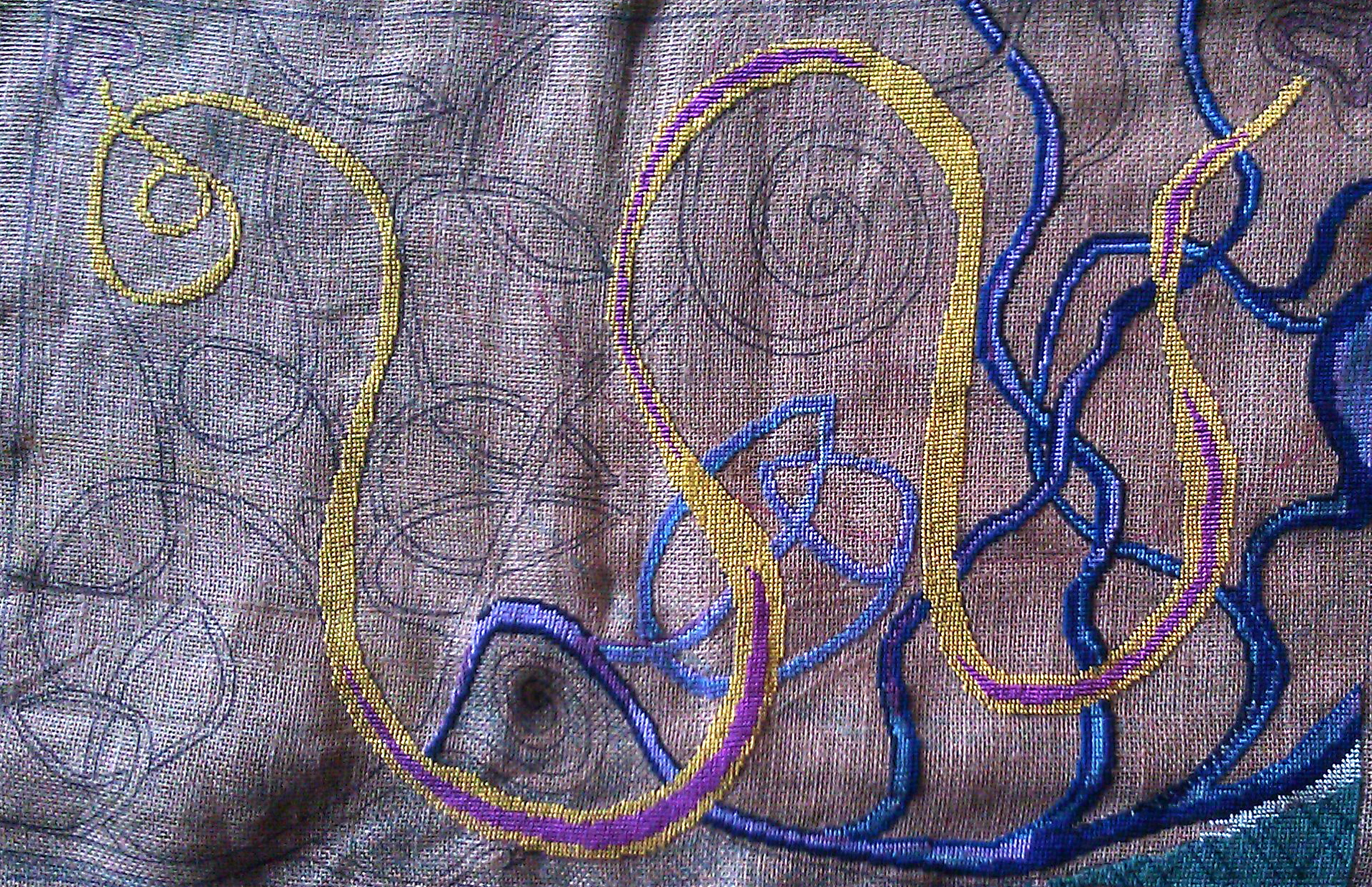
Having gone back to the hessian (burlap), for this one, I’m finding that although the stitches cover more quickly than in the last scrim piece, I’m having to stop and start a lot, moving the canvas around in my frame.
I know it’s not the way it’s normally done, but I just don’t like the idea of having the design rolled away so I can’t see it as you would on a traditional frame – I need to be able to see the whole design as I’m working, so I use a large square clip-on plastic frame – great, but it slows me down a little.
(I have considered making a much bigger frame, especially now that I have the floor stand, but I’m not convinced it would suit the ways I like to work, and would probably end up with a saggy middle – never a good thing!).
I treated myself to a handful of balls of knitting cotton last week – mostly Rowan Cotton Glace. I needed to find something that stitches up with a sheen, but without having to buy hundreds of embroidery skeins. The best thing I ever found was Debbie Bliss Pure Silk, but my local retailer has stopped stocking it. I might have to trawl Webland to find some more.

But I’m happy with the Rowan cotton – it stitches well and has a reasonable sheen, it also comes in the shades I wanted – something that’s not always easy to find. I never realised before I got heavily into needlepoint art, how much painters take for granted the ability to be able to go out and choose the colours they want off the shelf and then go home and mix up precisely what they want – we have to hope that we can find the shades we want, in a yarn that suits and at a price we can afford.
Yep, I think the day when I bite the bullet and try dyeing, might not be all that far away…
Anyway, the Celtic Swirl is definitely in progress – just don’t hold your breath.
Happy stitching.
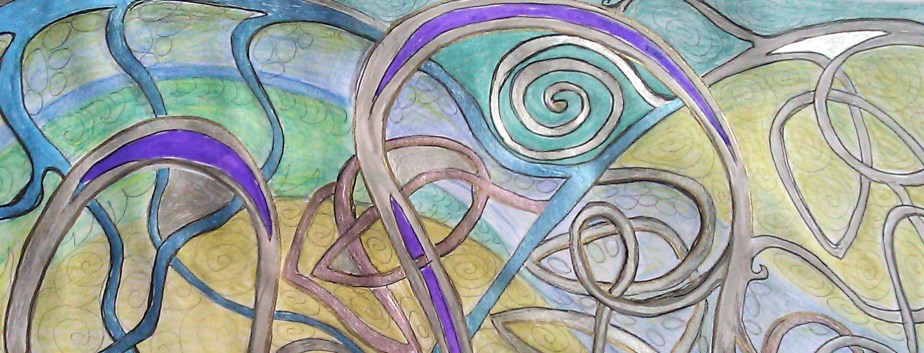
Here’s a sneaky peek of the design behind my new piece of needlepoint.
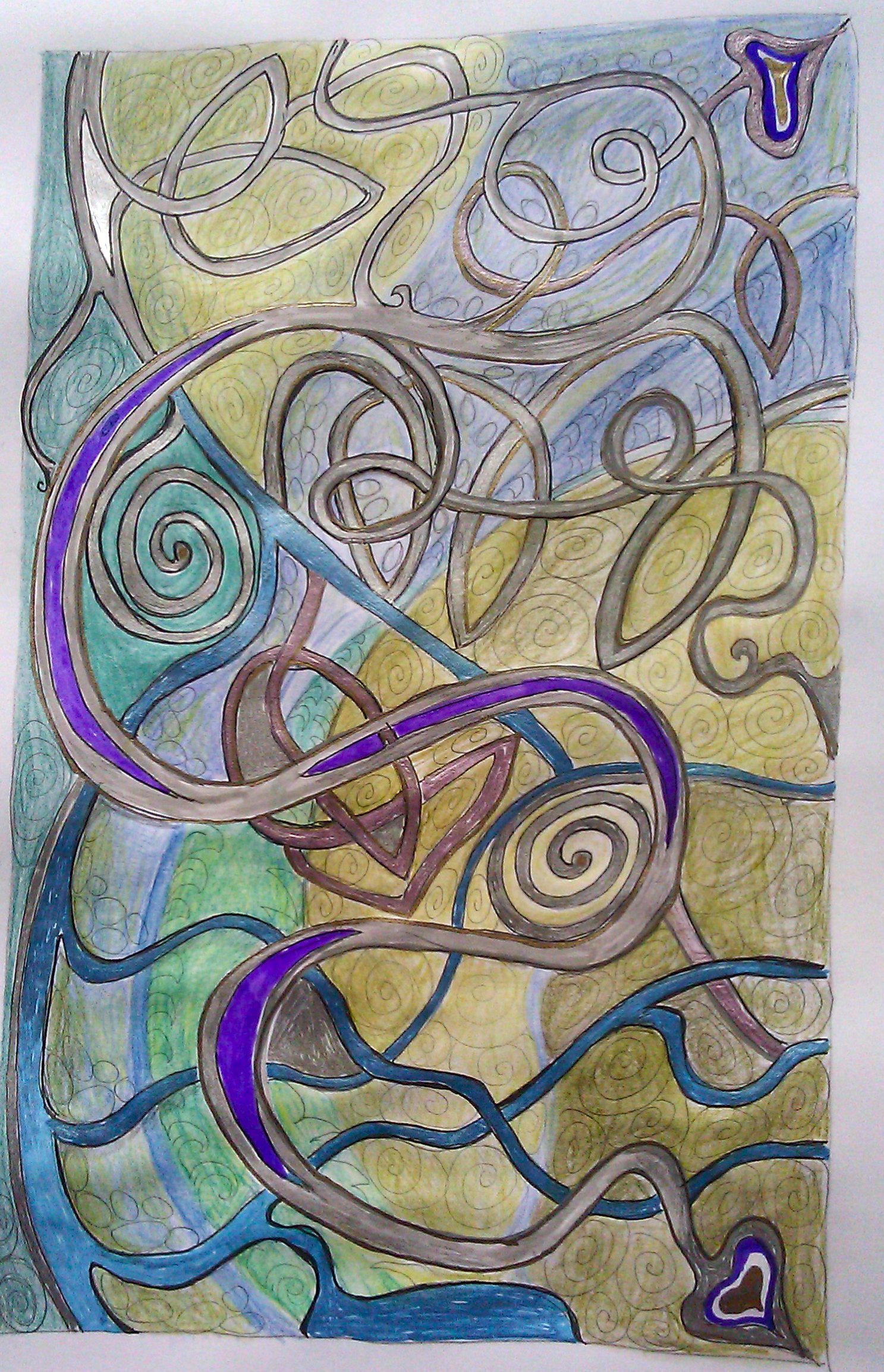
I’m going to call it Celtic Swirl – I seem to have spent most of 2012 sewing swirly patterns, which might tell you about the state of my mind – but at least this time, I can say that I have positively tried to incorporate a Celtic theme – albeit in a loose, freeform style.
I’m going to use the hessian for this piece – partly because I want to see how it feels to go back to the bigger holes after the last piece on the linen scrim, and partly because as I mentioned in the last post, my stocks of crewel wools and silks are a bit depleted and I’ll need to get out to find some new threads before I make another large piece on the scrim.
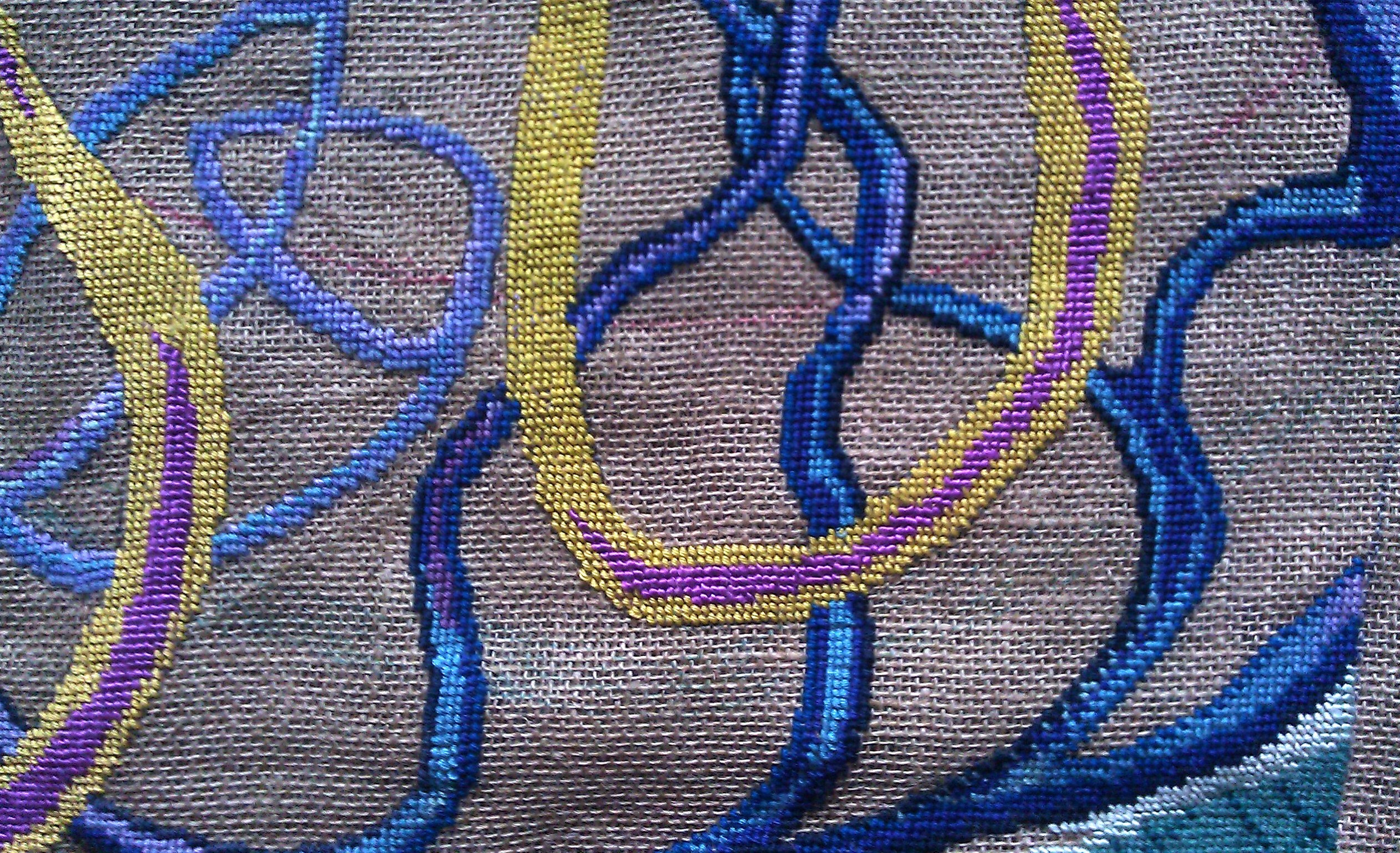
I’ve been drawing it up this morning – I’m not sure if this shows up, but here it is anyway.
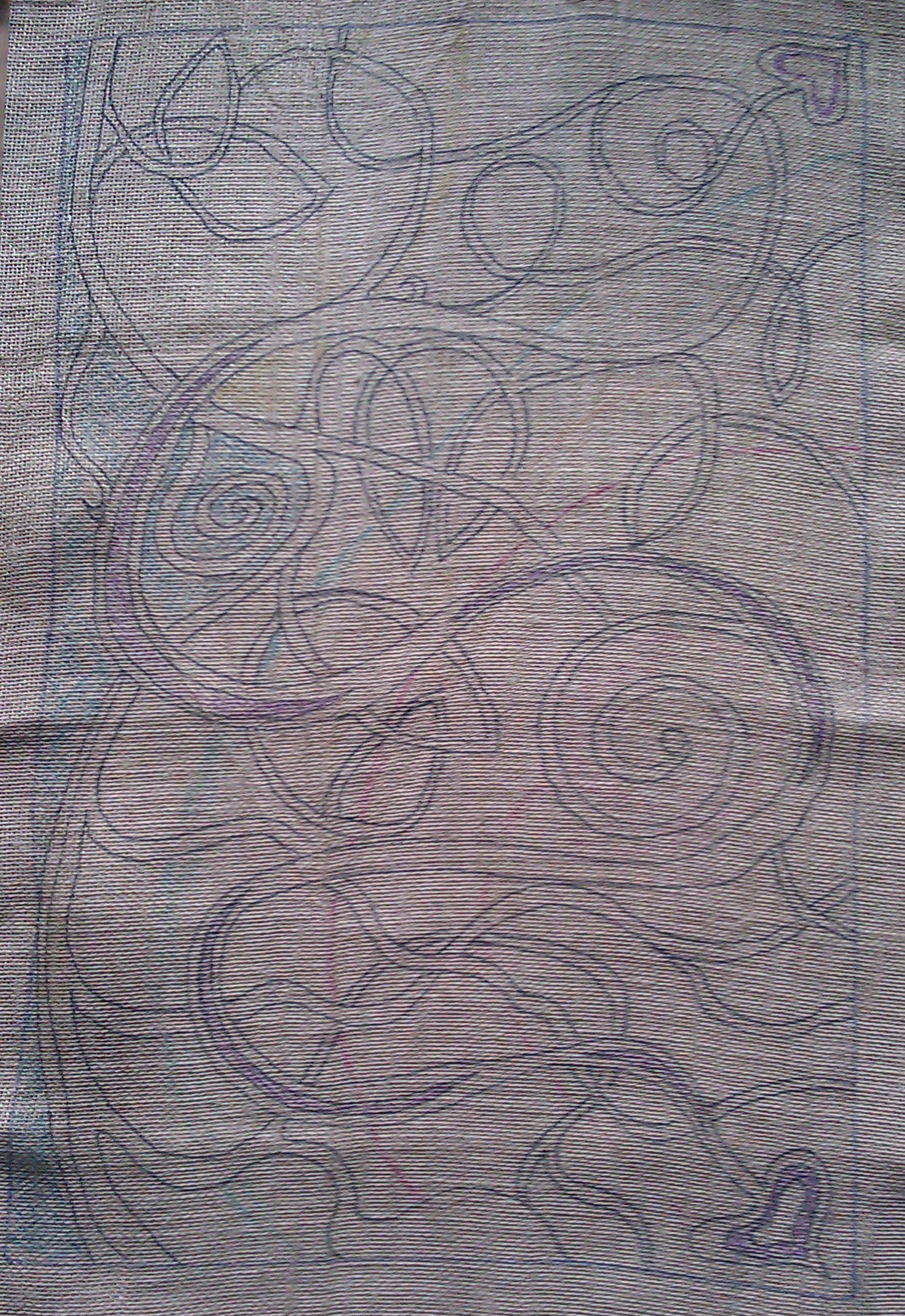
I like to have the main parts penned in, so that the form is maintained, but I prefer to keep the rest of it fairly fluid as I work.
As it stands, it’s about 28 x 18 inches.
So, off I go. Happy stitching everyone.
There’s a quote attributed to Woody Allen, that goes,
If you want to make God laugh, tell him about your plans.
Well, I think the gods must be having a good old giggle over me this week.
At the beginning of October, I (rashly as it turns out), declared my intention to draw trees every day of the month. I also promised a friend, that we’d have our long-delayed coffee and cake get together at the end of last week.
Well, you can guess can’t you, within hours of making those two simple plans, things started to go pear-shaped.
In the last two weeks, I’ve had two daughters laid up in bed with grotty colds, one husband laid up with man-flu, a nasty cold myself (not that that was allowed to get in the way…), and just as things looked like picking up, my coffee and cake friend’s daughter came down with the same bug. So, not much drawing, and no coffee and cake.
I haven’t been entirely lacking in the tree department, but that will be the subject of another post. This is just to say that with all the additional time sitting around with sickies, I’ve managed to finish the needlepoint I started on the linen scrim.

The finished piece is approximately 13.5 inches square. I had a quick look at calculating the number of stitches that have gone into it, – not something I normally do, but this was the smallest gauge I’ve ever needlepointed, and I was fascinated to know. The answer – give or take a few, is 72,900.
I started it at around the 8th of September and finished on the 11th October – so about a month. Not as bad as I thought it might be at the outset.
I’m telling you all this, because if I’m honest, although I liked the material, I was hugely daunted by the tiny holes when I began this, and I thought I might just call it an experiment. But having got into it, I’m not feeling nearly so negative.
The biggest downside, is that it really needs working in quite fine wools or silks, and my stock is mostly tapestry wools – too thick for the scrim. A good excuse for some more thread sourcing!
So, I think I can say it’s a thumbs-up for the linen scrim. I desperately need to find some new neutral colours to work in – I’ve realised that the stone texture piece won’t work with the palette I currently have available. I’m optimistic that I’ll find something suitable in knitting wool, but that will exclude the possibility of using the scrim.
Sounds like I have a bit of homework/shopping to do – could be worse – just don’t go telling anyone – please.
Some of you might know that the other great love in my life after needlepoint, is visiting historic places. (I generally write about that from time to time on my other blog – Mostly Motley).
What practically makes me drool with excitement, is when I get to combine both passions.
This happened to me back in August, when we visited Wallington, Northumberland (a country house now in the care of The National Trust).
Wondering around the house in the languid way I do these days (so much less stressful now the girls are old enough not to need supervising), I came across a simply amazing 6 panel needlepoint screen, in a room called – for no reason I could find out – The Pigeon Hole.
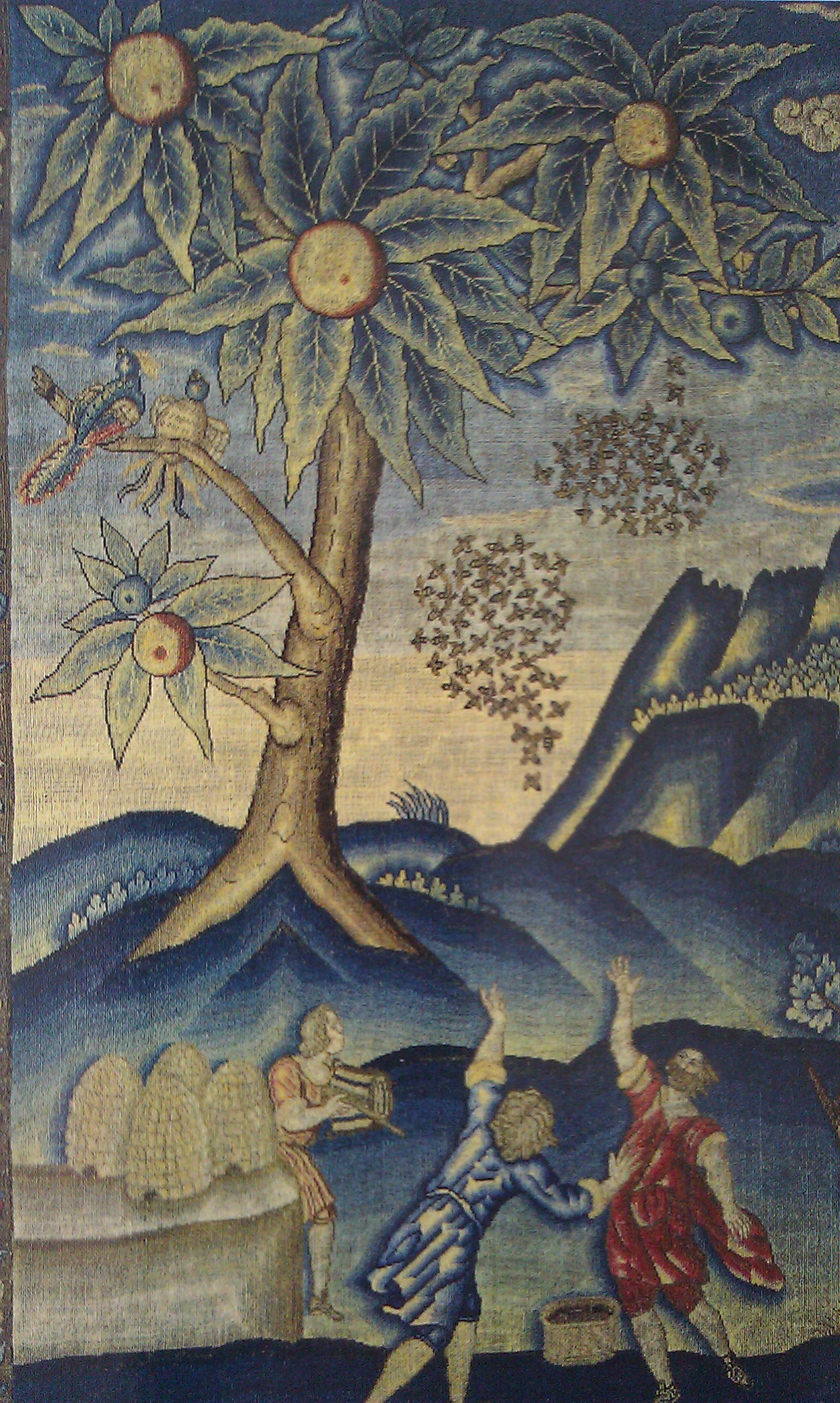
It’s a good job that my daughters now make their own way around these historic houses, because my habit of spending long minutes, peering intently at the stitching, is guaranteed to cause them huge embarrassment. Naturally I had a really good look at the panels and what overwhelmed me, was the sheer size and detail of the work and the tiny stitches with which it was constructed (petit point).
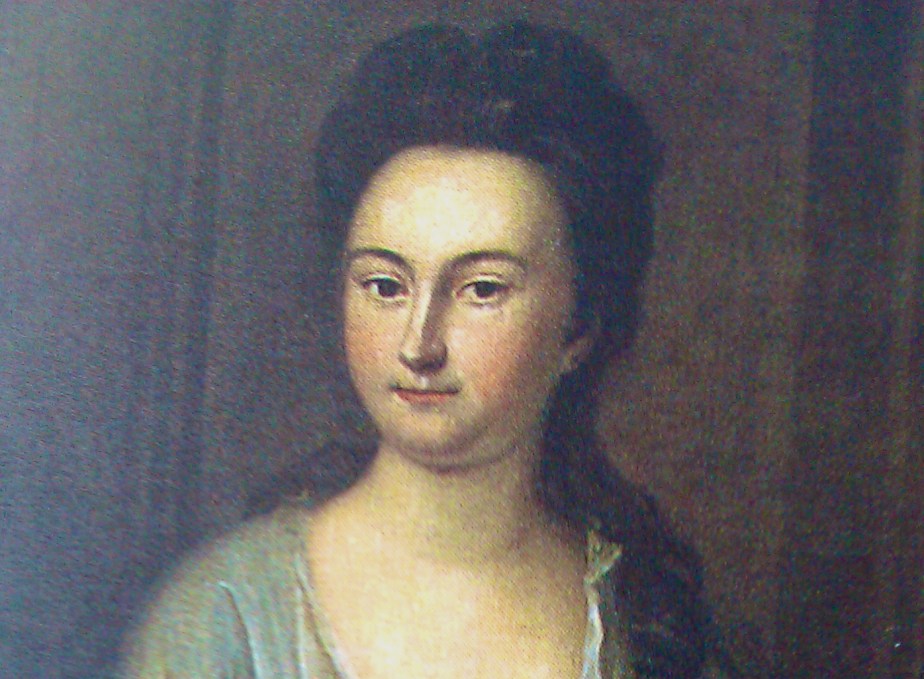
I’d rashly assumed that it was something purchased by the family for the house, but the lovely Room Guide pointed out a small portrait of a rather beautiful lady, called Julia Blackett, who I was told, had stitched the screen herself in 1727. The link to that portrait is here if you want to take a look.
According to the guide-book, the screen, which is worked in fine wool, was inspired by Wenceslaus Hollar’s 1663 edition of the Georgics and Eclogues of the poet Virgil. I’ll have to take their word on that, my classics education didn’t stretch that far, but I can’t help wondering about the thought process of Julia when she decided to create the work. Was she a scholar? Was this popular reading in seventeenth and eighteenth century aristocratic circles? Would the people who saw the screen, have understood what it was saying?
Then I wonder how she went about planning it. Did she have drawings? Did she create the drawings herself, or was there a market in needlepoint kits back then? How did she get the wool? Who supplied it? She certainly couldn’t order online!
Of course most people would assume that she had plenty of time on her hands to actually do the sewing, but I wonder about that too. It’s all very well in good daylight, but it must have been nigh on impossible to see well enough at night – have you ever done any fine work by candlelight? I suppose there must be a suspicion that she didn’t do it alone – if that’s true, I wish we knew a lot more about who the other women (I’m assuming it would have been ladies?) were.
I’d love to know more, because this is really what gets me so excited when I find old needlework. It’s the sense of connection with the individual whose fingers held the cloth and plied the needle, for hours and hours and many long hours. When we make pieces of needlework, we put something of ourselves into it – and in some way, that essence reaches out from the work.
I wonder if this is to some extent why historic quilts are so evocative – it’s a similar connection between the lives of people from the past and those going through the same process today.
Anyway, you can imagine, seeing Julia’s work made my day.
But then, just a few steps down the corridor, I came to the Needlework Room!
What a shock – it turns out that Julia had done far more than just the screen. The Needlework Room contains ten long needlepoint (tent stitch) panels, with an oriental theme – exotic birds and flowers. Annoyingly, I didn’t have my camera, so below are a couple of links to show the work.
Go here for a detail from one of the panels
And if you go here, you can see more of the panels There are beautiful almost matching chairs in the room too – you can just see them in the second picture, but they aren’t actually attributed to Julia.
Apparently, she made all these over a period of three years in the 1710’s, for the Drawing Room of her home in Esholt, near Bradford. It was her son, Sir Walter Calverley Blackett, who had the needlework brought to Wallington in 1755, when he sold the Bradford property. I’m so pleased that he was proud enough of his mother’s work to preserve it in his new family home, creating a room especially to show it.
I’ve tried to find out a little more about Julia Blackett, but she remains elusive. We have a couple of portraits and we have her needlework and we know that she was born in 1686 and died in 1736 – that’s it. Wouldn’t it be wonderful if somewhere in the family archive, there were letters or diaries that could tell us more. In the absence though, we can look at her work and let our imaginations soar.

Julia Blackett – needlepoint heroine.
This post is by way of a ‘thank-you’ to several people and companies who’ve helped me out over the last few weeks.
If you’ve been following my stitchy ramblings, you’ll know that I’ve recently started needlepointing on a piece of linen scrim (scrim supplied by MacCulloch & Wallis – thank you).
It was a bit of a shock to the system after all the hessian I’ve used over the early part of this year, but with a lovely texture that quickly had me hooked.
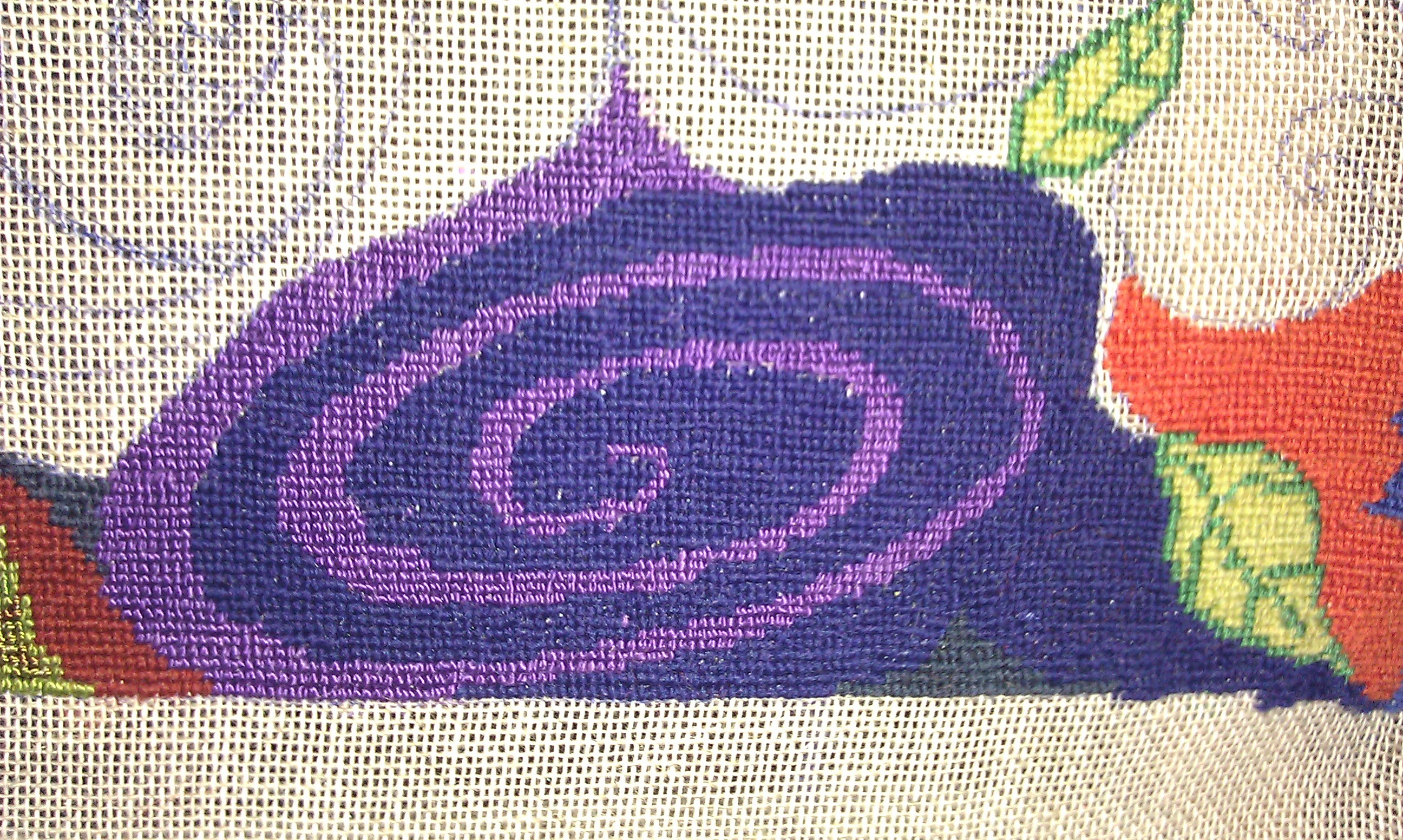 But… those tiny holes…
It’s not the number of them that’s the issue, it’s seeing them – they are sooooo small! In anything less than brilliant daylight, I’ve been struggling to stick the needle anywhere near its proper destination.
The problem is so much more difficult in the outer corners of the design, where not only am I trying to find the holes, but it’s impossible to keep the frame steady without growing an additional arm or two.
Arrrgh!
Then came the lovely Janet Granger to the rescue. You know how sometimes in Webland, there’s a sort of synchronicity – well, just as I was struggling in the dratted corner, I read this post from Janet ‘My trusty needlepoint floor stand...’
I’m not a natural with frames, but the last 12 months or so has seen me experimenting with a variety of different ones, but the idea of having a floor stand – well, that was revolutionary. It also brought on a touch of image consciousness. Am I the only needlepointaholic who has to deflect jokes about it being something medieval ladies did in the solar… a floor stand would surely do nothing to bring needlepoint into the 21st century.
But faced with the alternative of a twisted shoulder and impending blindness, what was I to do? I took Janet’s advice and bought a floor stand.
IT’S BRILLIANT! (thank-you Janet, – and a huge thank-you to Theresa at Stitchaholicswho somehow contrived to have the frame with me less than 24 hours after I ordered it – wow.)
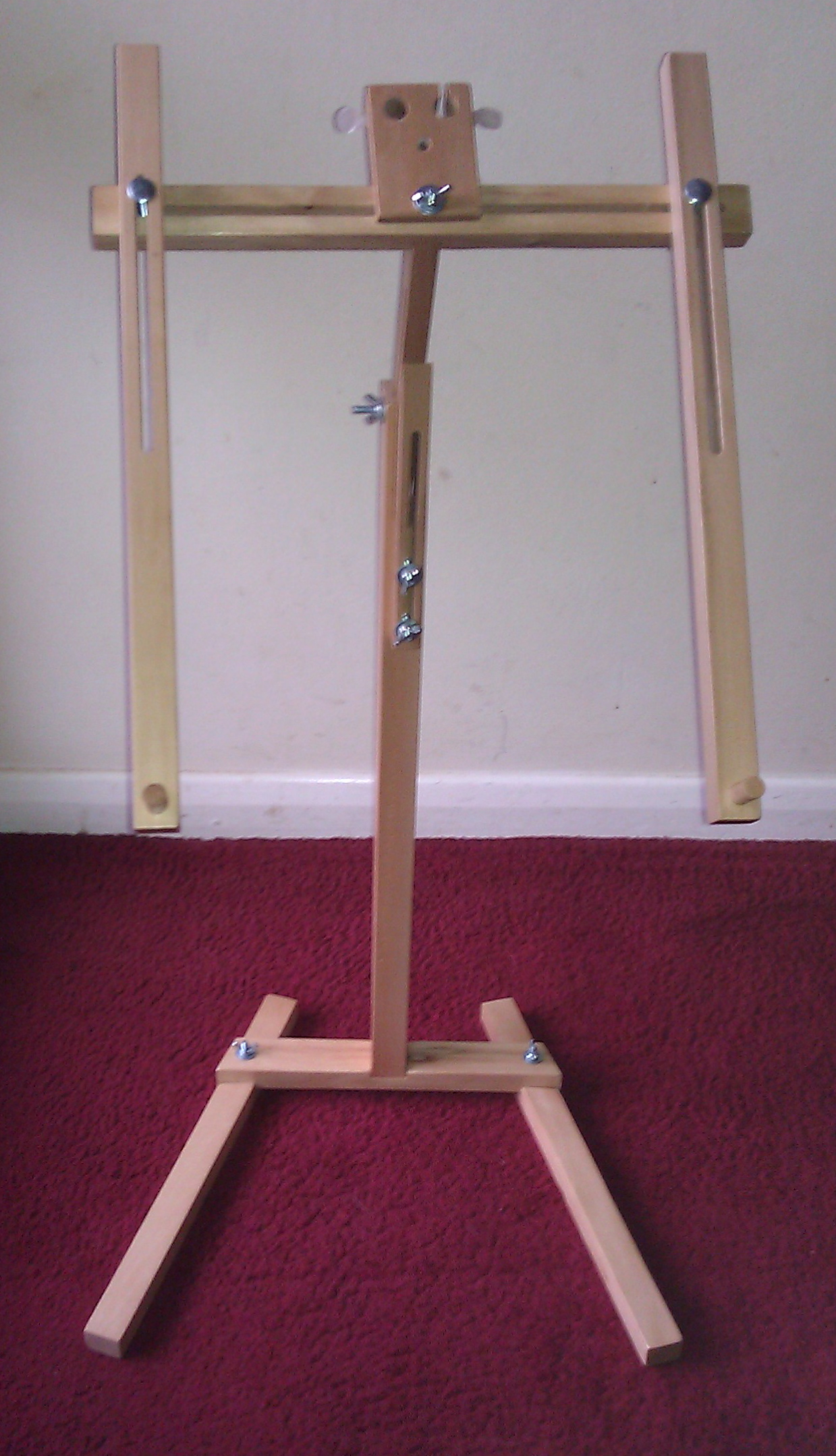
I didn’t order the light or magnifier – I thought I’d try the frame out for a few days first, to see if we’d be friends.
Having both hands free is liberating – who cares if I look as if I should wear a wimple.
But I still needed to shine light into those dark corners.
We had an old clip on lamp from IKEA that I thought would do the trick and it probably would have, if we hadn’t managed somewhere along the way, to lose the transformer it plugs into. The husband thought it would be quicker and cheaper to go and buy a new lamp, so off I went to IKEA…(I don’t normally need asking twice if there’s the prospect of a trip to IKEA)
And so, here it is – a little JANSJO lamp (thank-you IKEA – £10) – just the job. Bright, flexible and lightweight. They come in some fabulous colours, but I played safe with white. 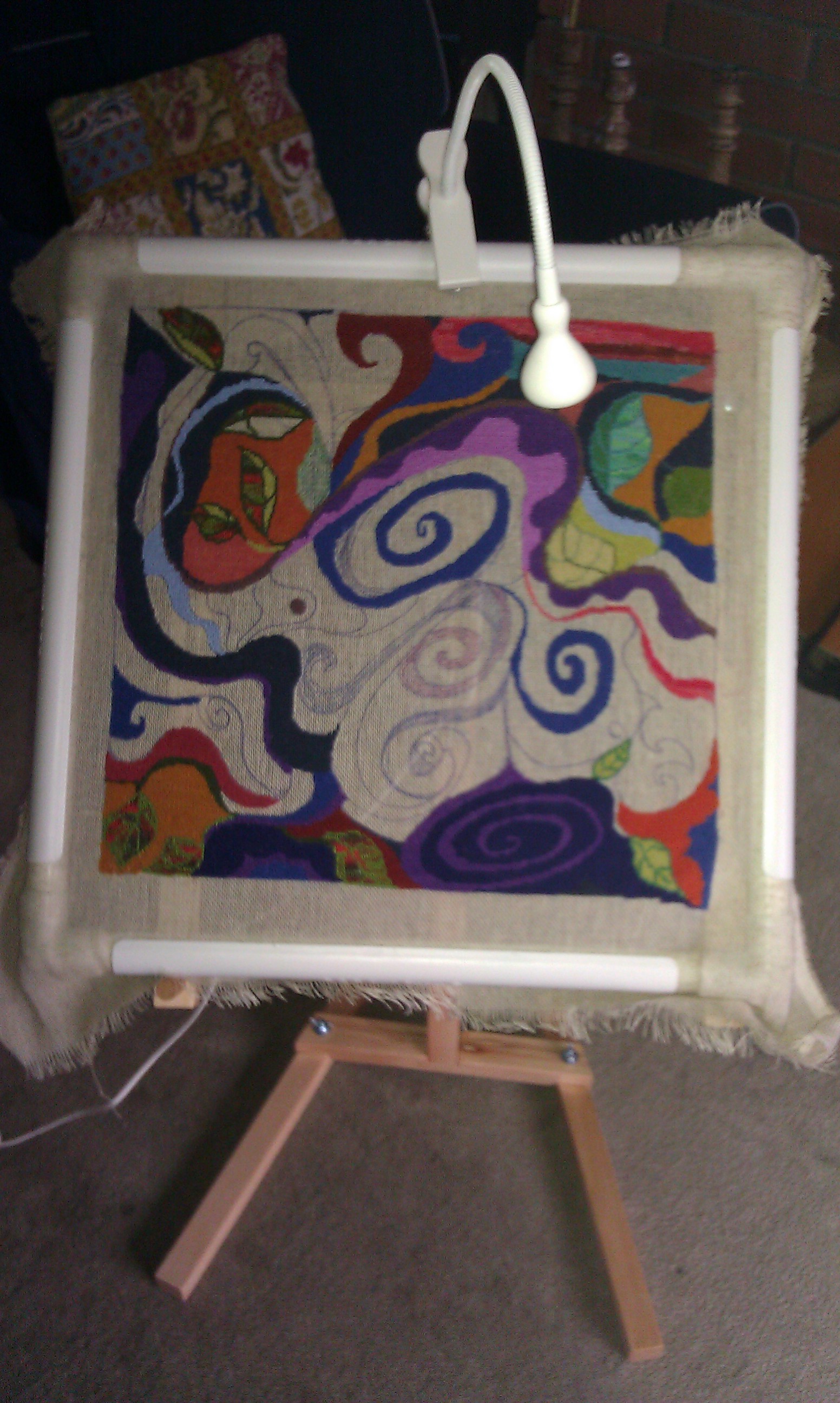 Beats candles I suppose.
Have you ever visited ruined castles or very old manor houses, with window seats set into the walls? Well, I know exactly who sat in them and what they were doing.
So far, I don’t think I need the magnifier – the light is good enough, but we’ll see.
And finally, this is what the scrim piece looks like at the beginning of this week. 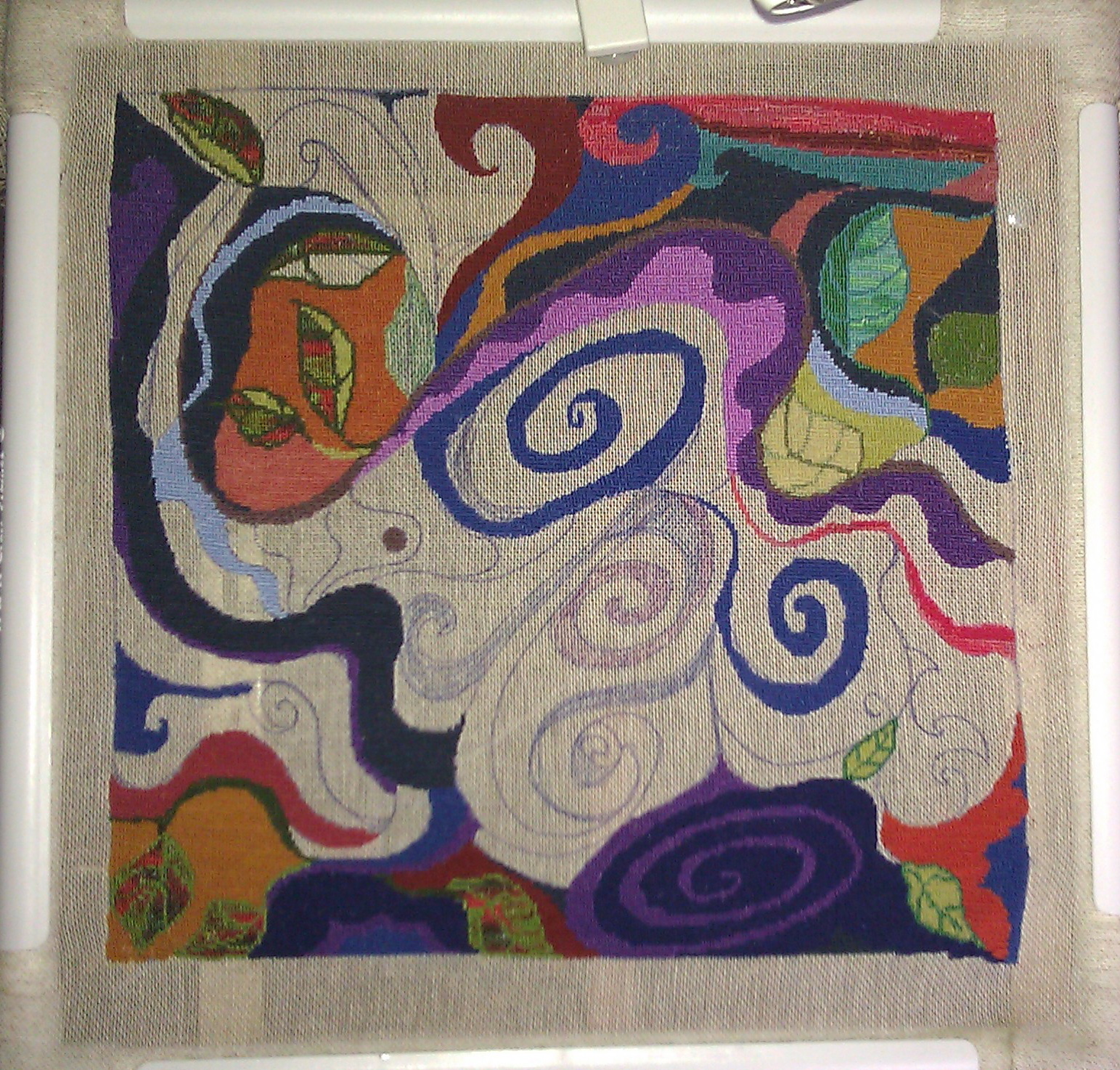 Happy stitching.
Just when I thought I’d sorted out what I’d be doing for the next few weeks, along comes the delivery of linen scrim, and within no time at all, I’m diverted off on to another track.
I wanted to try the scrim, because although I adore the variable, loose weave of the hessian that I’ve been using, it is hairy and I think gives me a few issues with sneezing and sore hands.
Linen scrim seemed to be a useful alternative.
I quickly set up a piece on the 17″ frame – it felt as if it needed a frame – and put needle to the canvas.

The first thing that struck me, was that this scrim is going to take a lot of stitching – sooooo many stitches! (I estimate about 20 stitches per linear inch – 400 per square inch). I’m not afraid of working large or slow pieces, but this felt a touch daunting.
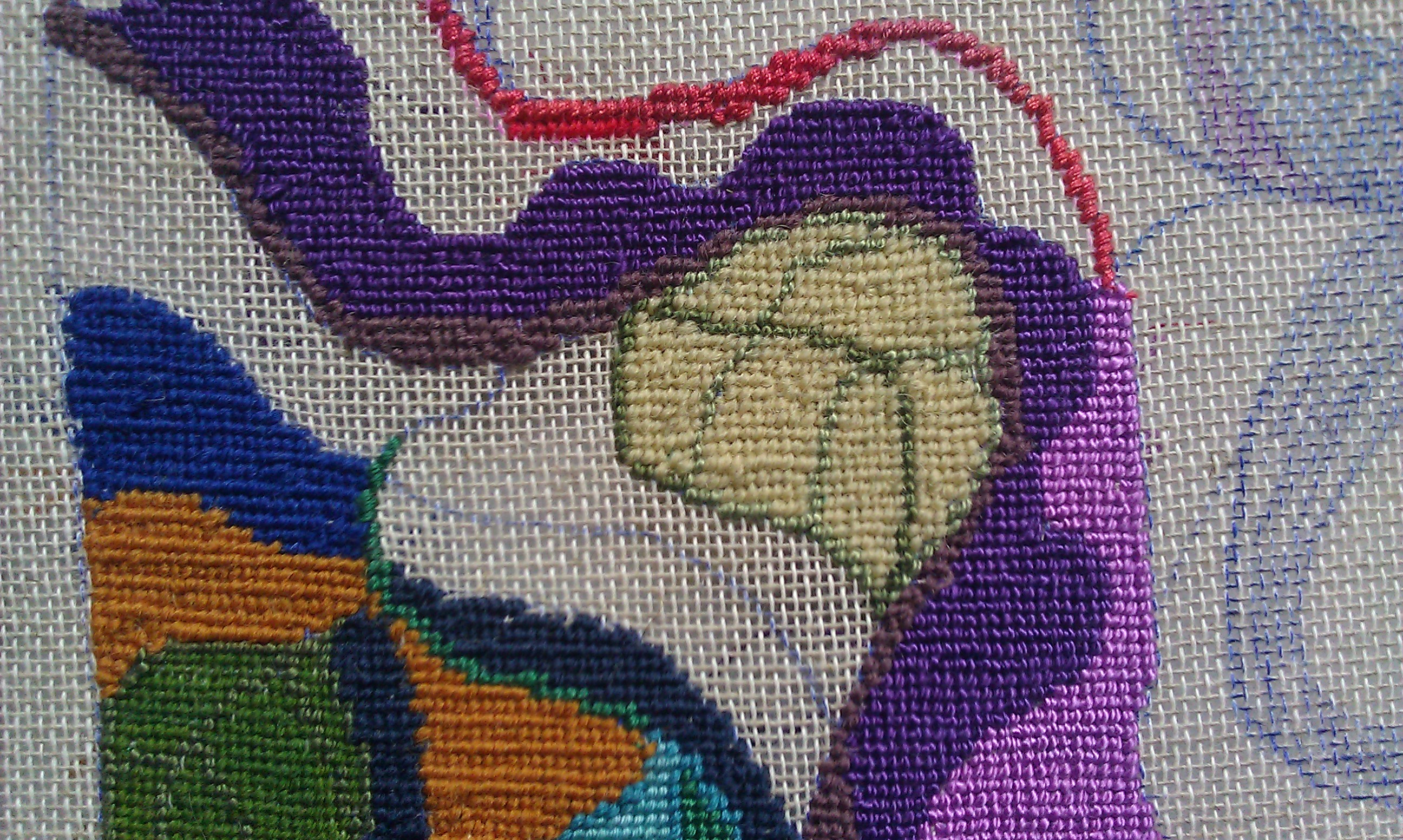
But once I’d experimented with different strands of wool/silk/cotton, I found I’d somehow become attached to it. I had originally thought I’d just do a few square inches to see how it worked, but now I’m sure I’ll carry on with it.
As with the hessian, I find that the softer canvas feels attractive to work on.
On the plus side of using the tiny gauge, I now have a good excuse to use some of the yarns I’ve been keeping from Stef Francis and Oliver Twists – yarns that would have been lost on a bigger gauge piece. I’ve also tried out some Anchor Perle cotton. It fascinates me how each different type of thread lies down in the canvas with its particular character.

So, a delay on progressing the stonework idea – but a bit of an education going on instead.
Happy stitching.

It’s been a wonderful summer. I discovered years ago, that trying to work when the girls are at home just isn’t an option for me. Rather than worry about it, I now give up all ideas of stitching while the schools are out and instead try hard to give the girls a good time.
They’re growing up so fast. I don’t have to be chief entertainments officer anymore, they pretty much decide their own schedules these days, but they certainly do need a taxi service, and too often, they also need the Bank of Mum on hand.
So for the last five or six weeks, there’s been nothing happening on the canvas.
But up there in the brain, all kinds of ideas have been spiralling around.

While we were in Scotland, we visited Balvenie Castle. It’s a beautiful gem which I’m sure gets missed by a lot of people because it nestles beside the Glenfiddich Distillery – a great tourist attraction (and well worth the visit).
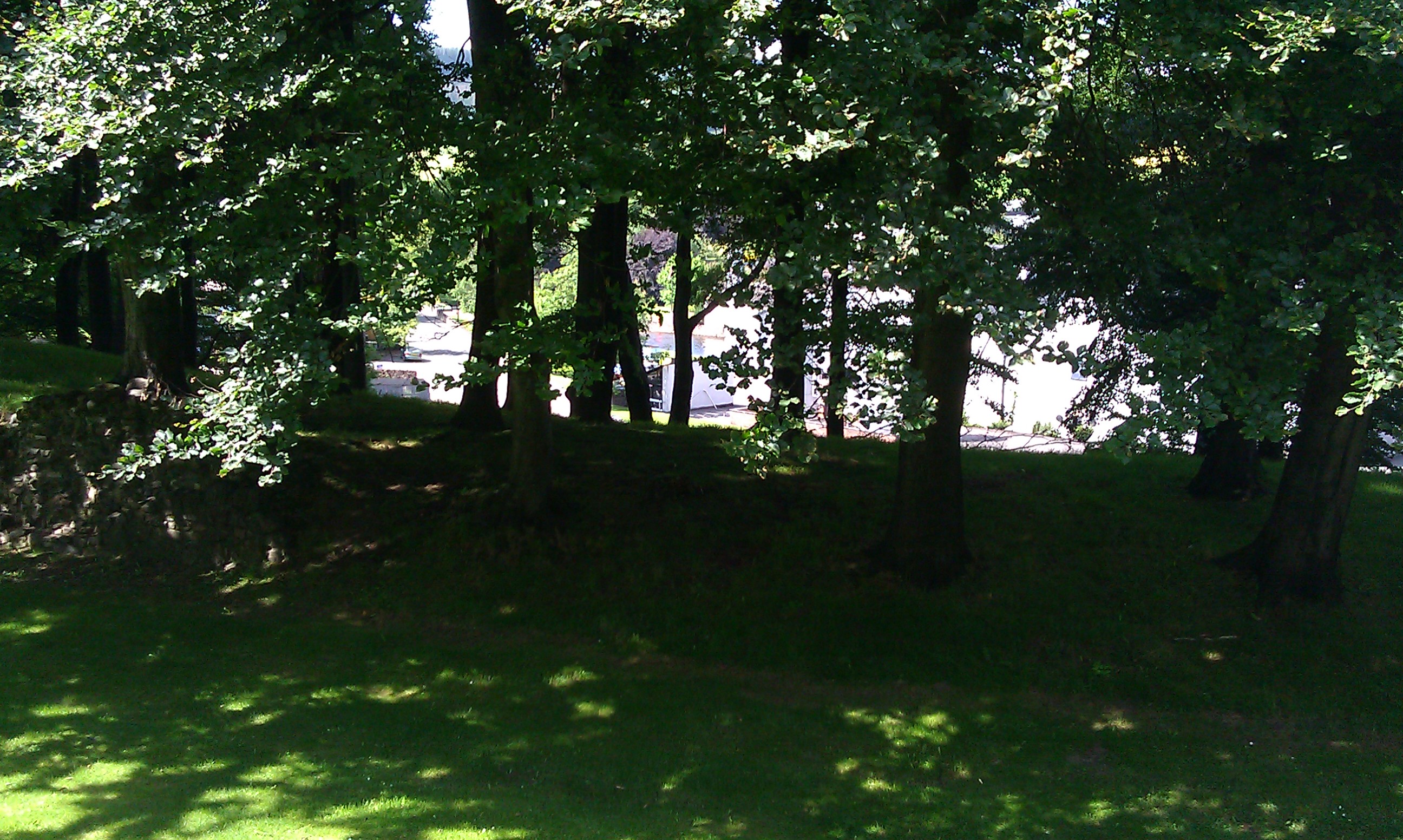
But the castle has wonderful stone work, which has really made me tingle with desire to somehow recreate the colours and textures of the stone.

It was a very hot morning when we were there, so I sat in the shade, staring up at the masonry, whilst breathing in the delightful aroma from the distillery – and mulled over the stitching possibilities.

It’s on my list for the autumn.
Although I haven’t been sewing, I’ve had a bit of a go at sorting out the canvases. This autumn I’m going to give linen scrim a go. The hessian that I’ve been experimenting with is very enjoyable in lots of ways, but the hairiness plays havoc with my nose and I’m a tad concerned that I might be allergic to it – the eczema on my hands improves a lot when I stop using it.
I’ve just ordered a few metres of scrim, so when it arrives, I’ll have a little play and see how it feels.
The texture and weave of the canvas has become much more important to me over recent months and I realise that I tend to respond better to more pliable substrates.
I’ll keep you posted.
I’m craving some nice new yarns to sew with. Can anyone recommend sources of wools, silks, cottons or anything else that’s a bit out of the ordinary? I feel a trawl around the internet might be in order, but how much more lovely it would be have a shop nearby where I could touch and feel in person.
So, gearing up again now. Should be back in action soon.
Happy stitching.
So here it is…
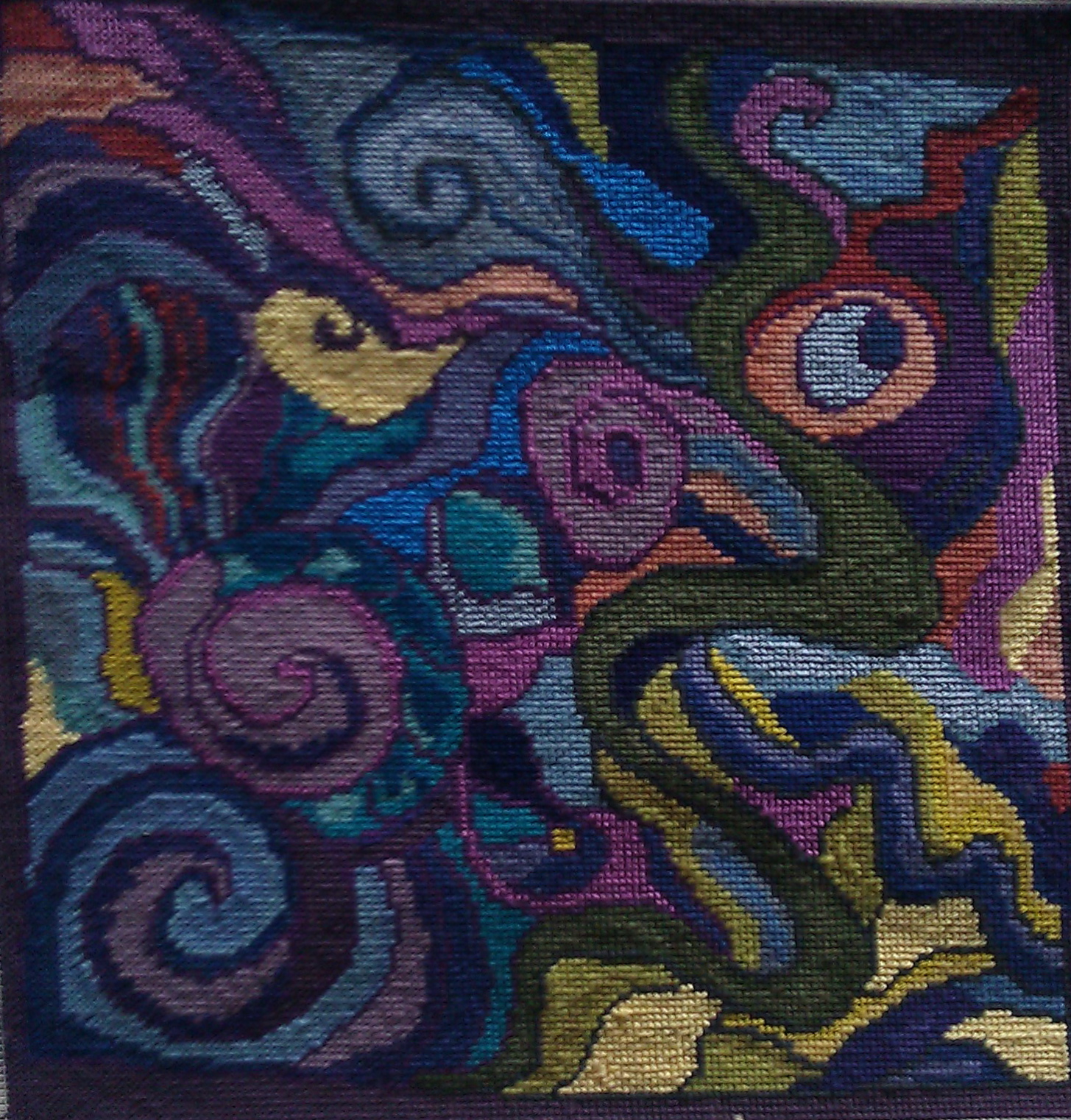
The piece inspired by stained glass – although as I’ve been stitching, I’ve had a decidedly underwater feeling.
I’m not sure that it’s quite so dark in real life, but the pictures taken with flash make it look very odd indeed – almost yellow, which it certainly isn’t. I don’t know, perhaps Father Christmas will put a nice shiny digital camera in my stocking this year?
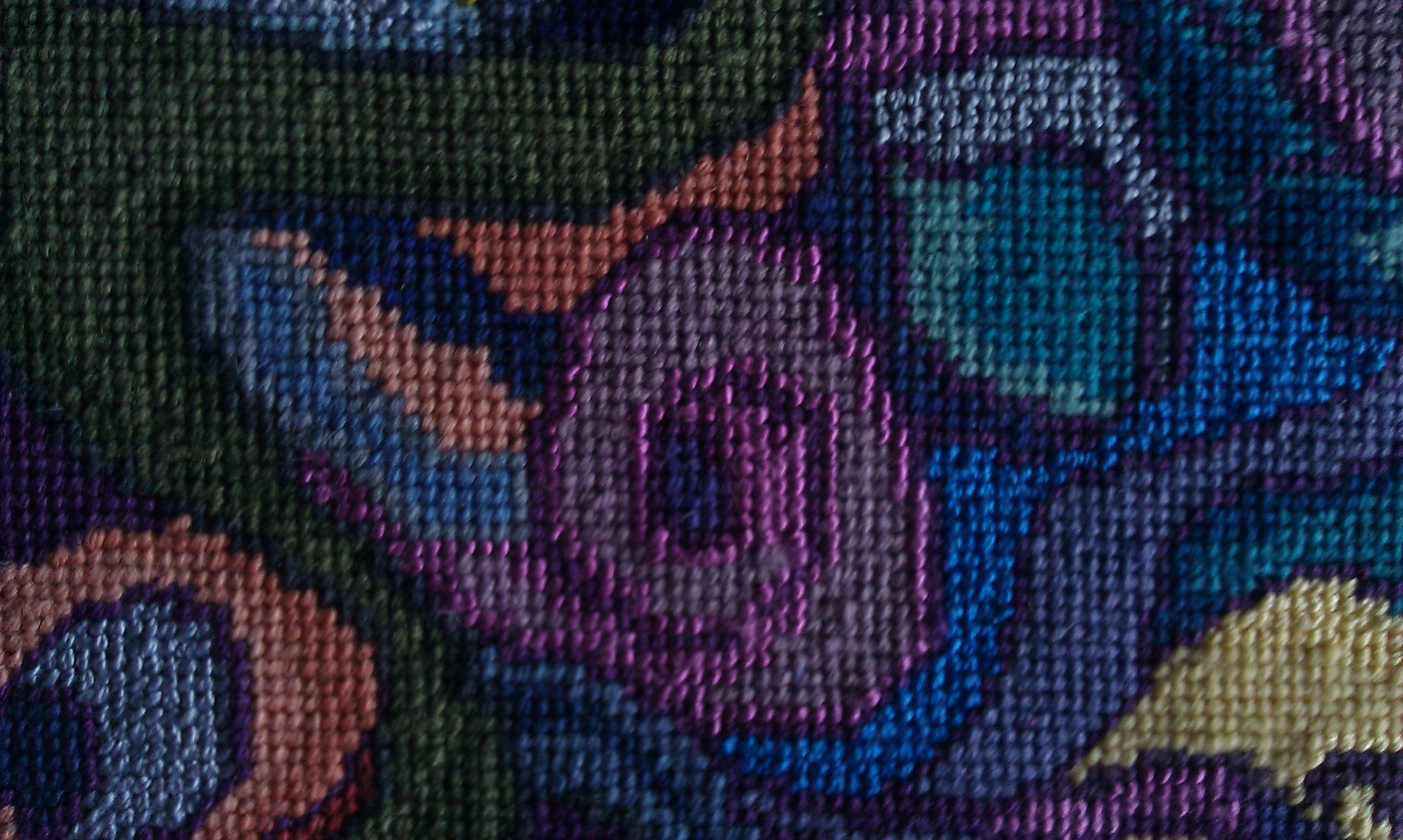
I’m reasonably pleased with the way it’s turned out. The combination of silks and wools has given it the shimmer I wanted, to convey the way that light works through stained glass.
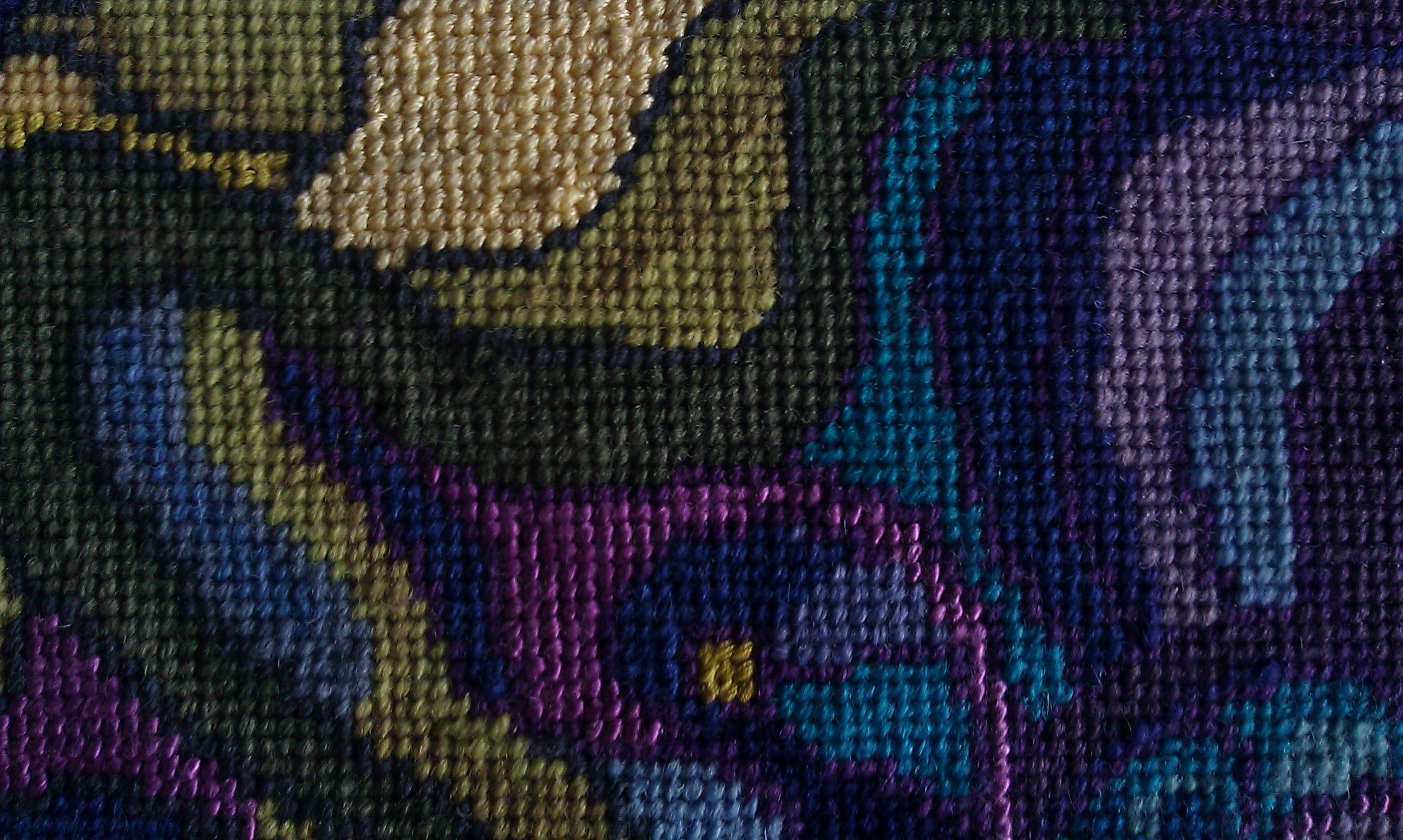
I could sit for hours in a church where the sunlight is casting rainbows across the stonework. True magic.
Today we start the packing for our trip to the far north of Scotland. Weather permitting, we’ll be away for a few weeks. I’m not taking canvas with me – I did last year and never got it out of the bag. Camping, wind, rain and cold I discovered, don’t lend themselves to happy stitching.
I am however, going to take my sketchbook. This will be a wonderful opportunity to get back to basics and start laying down some new ideas to work up in the autumn.
Happy summer everyone.
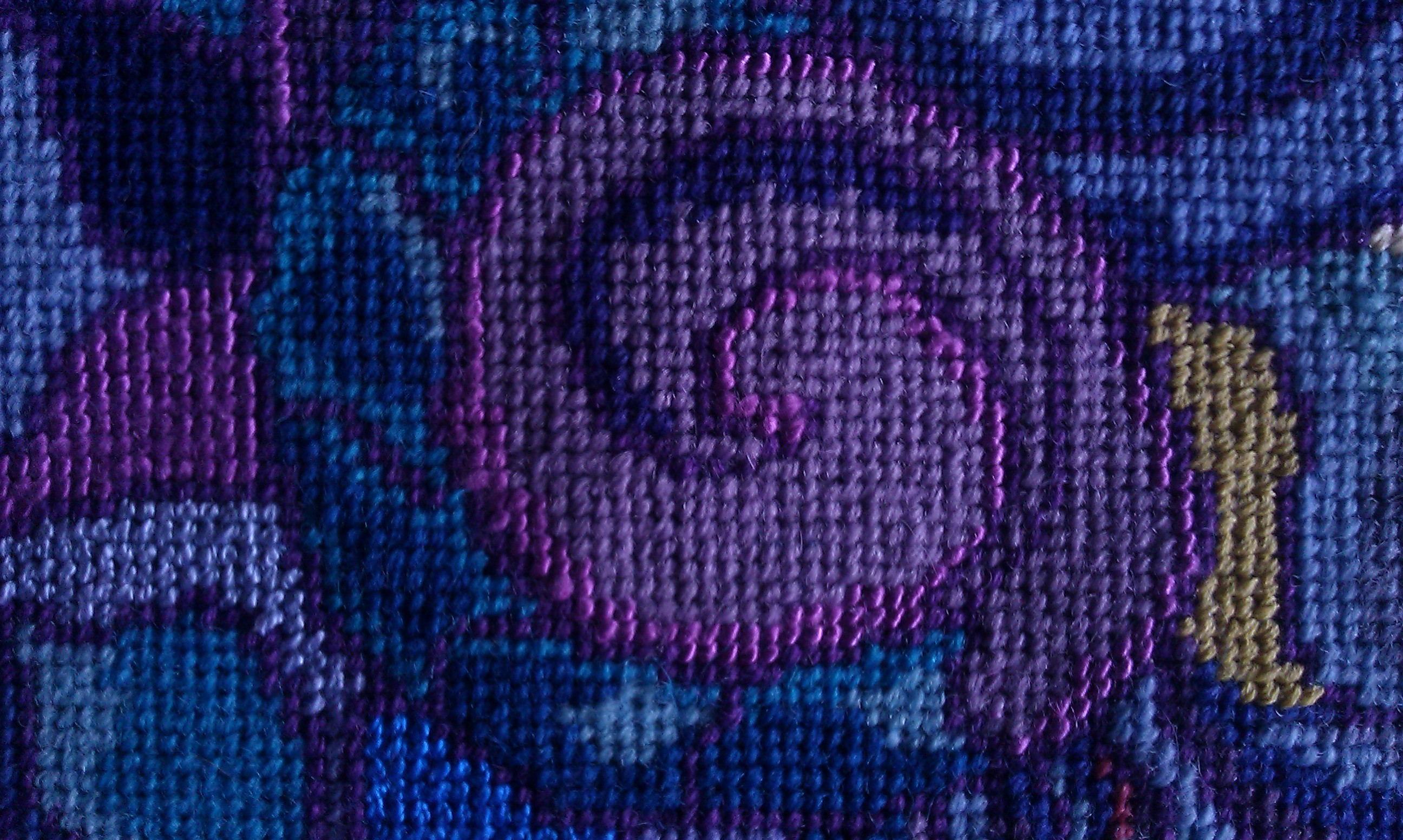
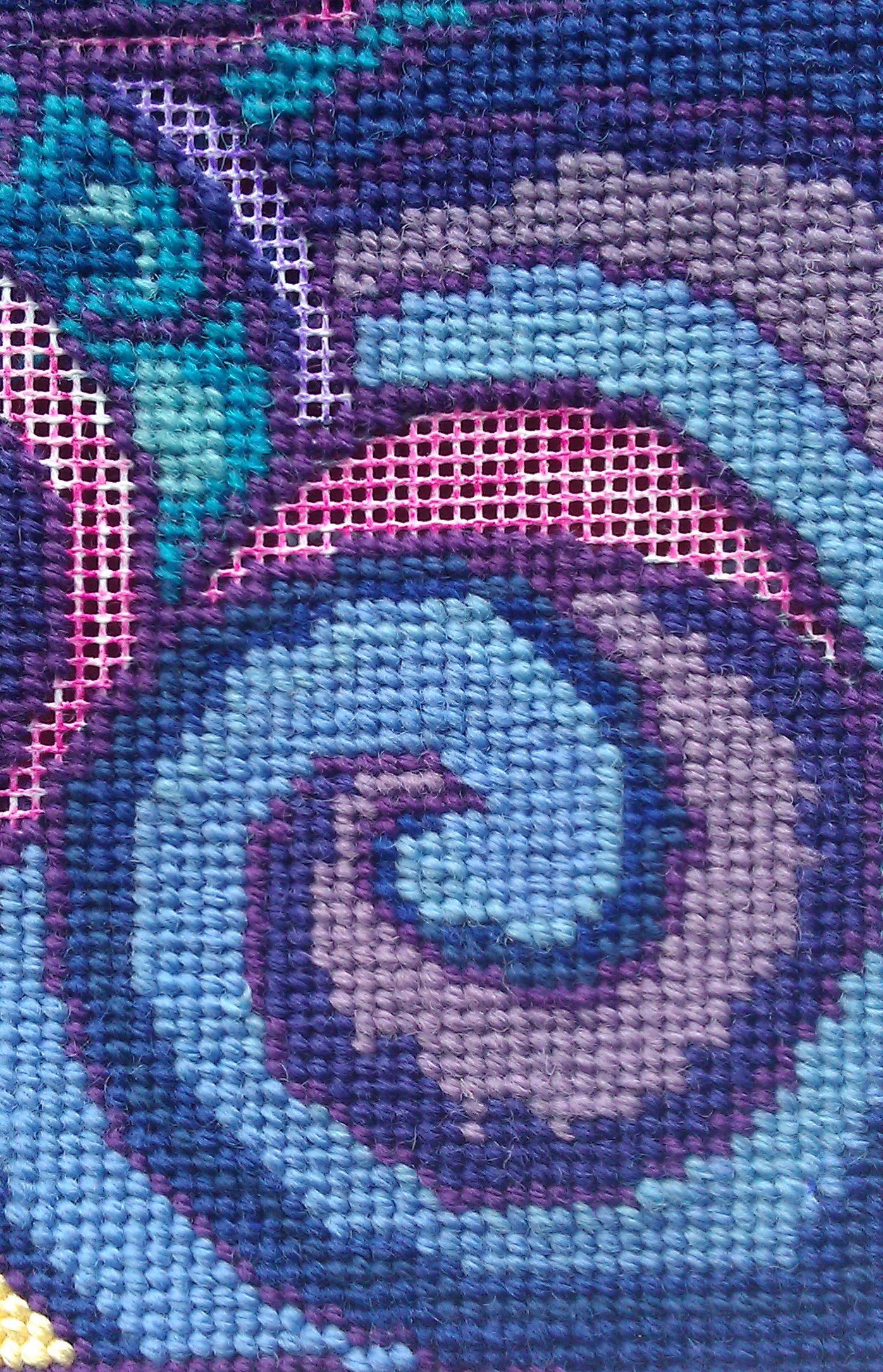
I started by stitching in the ‘lead lines’, so that I’d have some structure to work into. I’ve learned from previous pieces, that trying too hard to put a lot of heavy lines doesn’t work well, so I’ve been a little more restrained this time and varied the colour too.
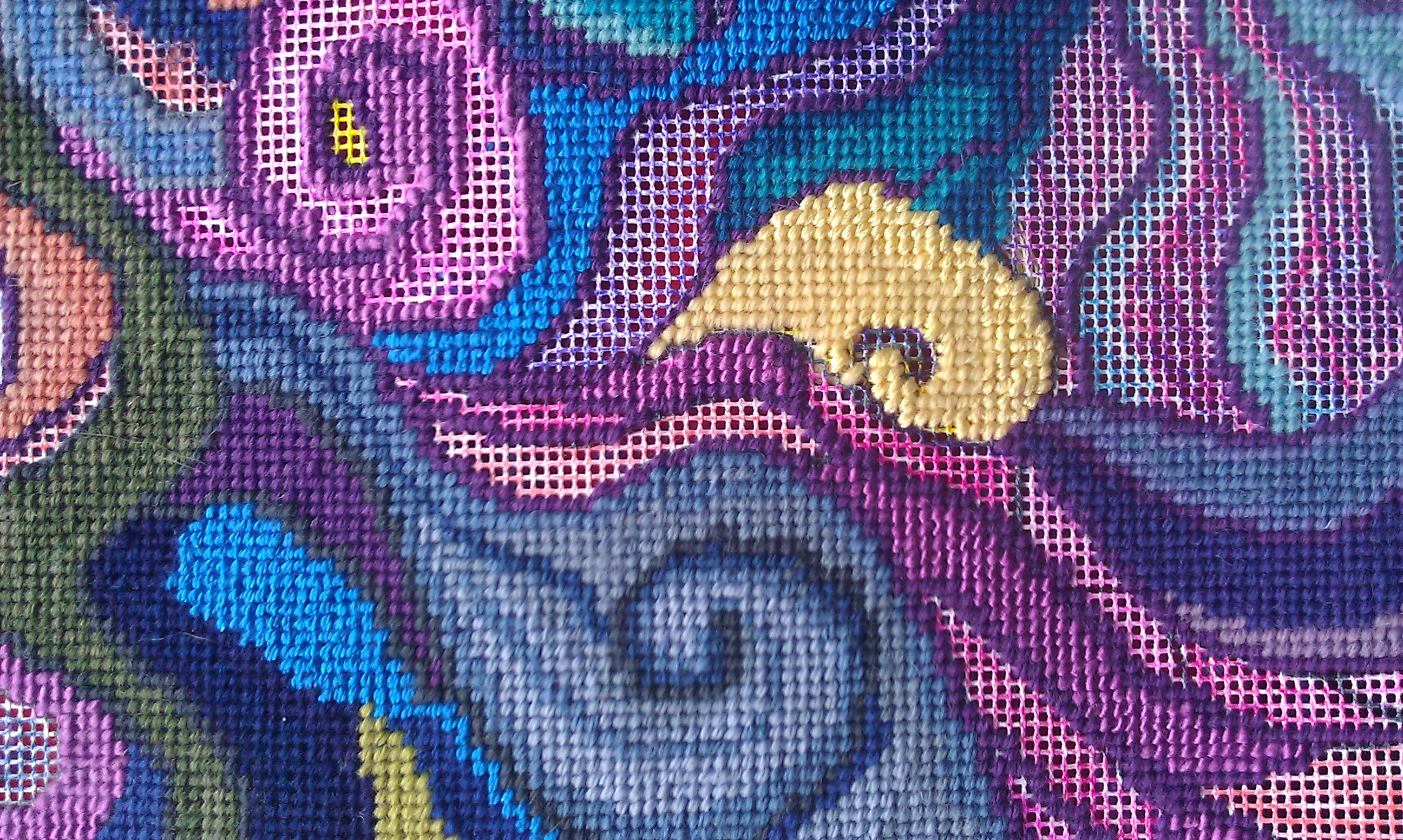
Then I began to fill in the shapes created by the lead lines. This feels a bit like stitching by numbers and is actually very relaxing.
But one of the things I love about old stained glass, is the imperfections in the glass itself, which create wonderful colour textures. I’ve tried to produce this effect in some of the sections.
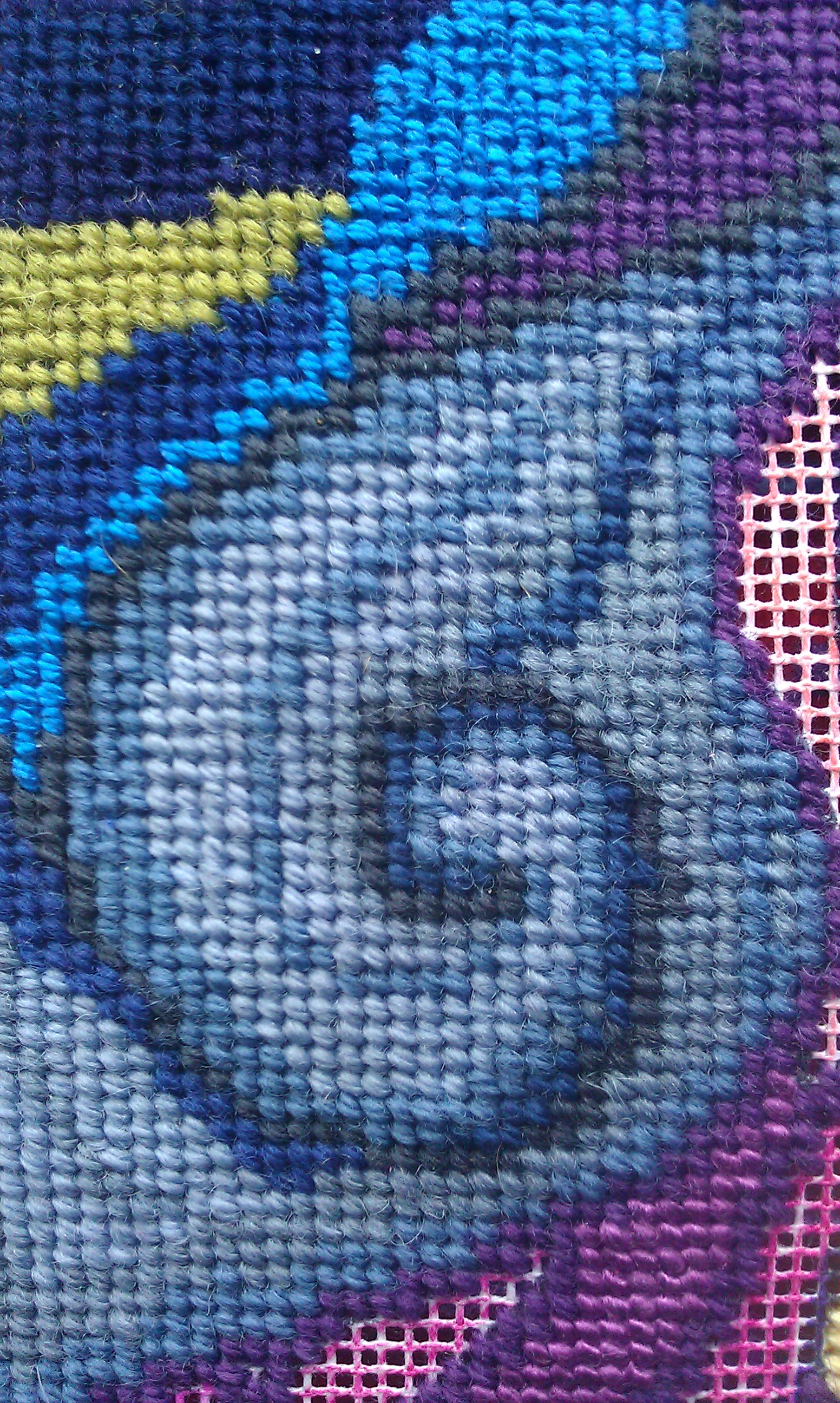
Of course the other thing which appeals to me about stained glass, is the way that light plays through the glass, making some pieces glow, while others remain dull.
So it seems like the perfect excuse to add perles and silks into the tapestry. They catch the light so differently to wool, adding a tingle of translucency.
I’d say I was about half way now with this piece. With any luck I’ll finish it before we hit the road with our little tents and go on our Scottish Odyssey, timed – rather deliberately – to coincide with the Olympics.
Happy creating!
Do you schedule your blog posts?
I only ask, because every time I decide to try to be more organised, life seems to get in the way. Still, here I am, just to say that the Shell is now well and truly finished (that is to say I’ve put all the stitches in, framing is another question altogether).

And, as planned, I’ve already started on the new Stained Glass piece.

It feels a bit odd to be working on proper canvas again. I definitely don’t like the way it makes my eyes see strange patterns when I’ve been working on it for a while – although I suppose it is one way to remind myself to take regular breaks.
But the fact that it is small enough to fit a 17″ frame, means I have some prospect of completing it slightly faster than the last couple of pieces.
I seem to need a relaxation piece to work on while I stew my creative juices for another bigger work.
Little droplets of inspiration have been finding their way through the morass that is my brain, but they’ll need to stay there incubating for a while yet.
Happy stitching/painting/creating!





 Dreaming In Stitches