On my mission to draw/paint daily – today it’s been Dunstanburgh Castle.
Dunstanburgh Castle
I started off with pastels. It’s so easy to get the basic structure with pastels. But I just couldn’t get the effect I felt I wanted, so after a while, I added some acrylics. It helped, but then I lost some of the texture that I was enjoying, so I was a real devil and added some more pastels – I’m having a bit of a ball combining media.
Anyway, just to be entirely rash, I then painted in the castle in, wait for it…watercolour.
Have you been to Dunstanburgh Castle? It’s a gem. There’s a bit of a walk to get there, along the coast. The castle is there, tempting you forward, with it’s imposing gate towers and slightly wonky angles. I love it.
I’m sticking pretty well to my daily creative commitment, although I seem to have spent more time with my needlepoint than with the sketchbook. Never mind, it’s all doing me good.
The thing that’s bothering/interesting/engaging me at the moment, is shading.
The piece that I’m working on is inspired by stained glass windows and what I wanted to achieve, is a feeling of the texture of glass as light moves around it. Now this I feel needs some shading.
This is how it’s coming along – should keep me busy for a few months yet.
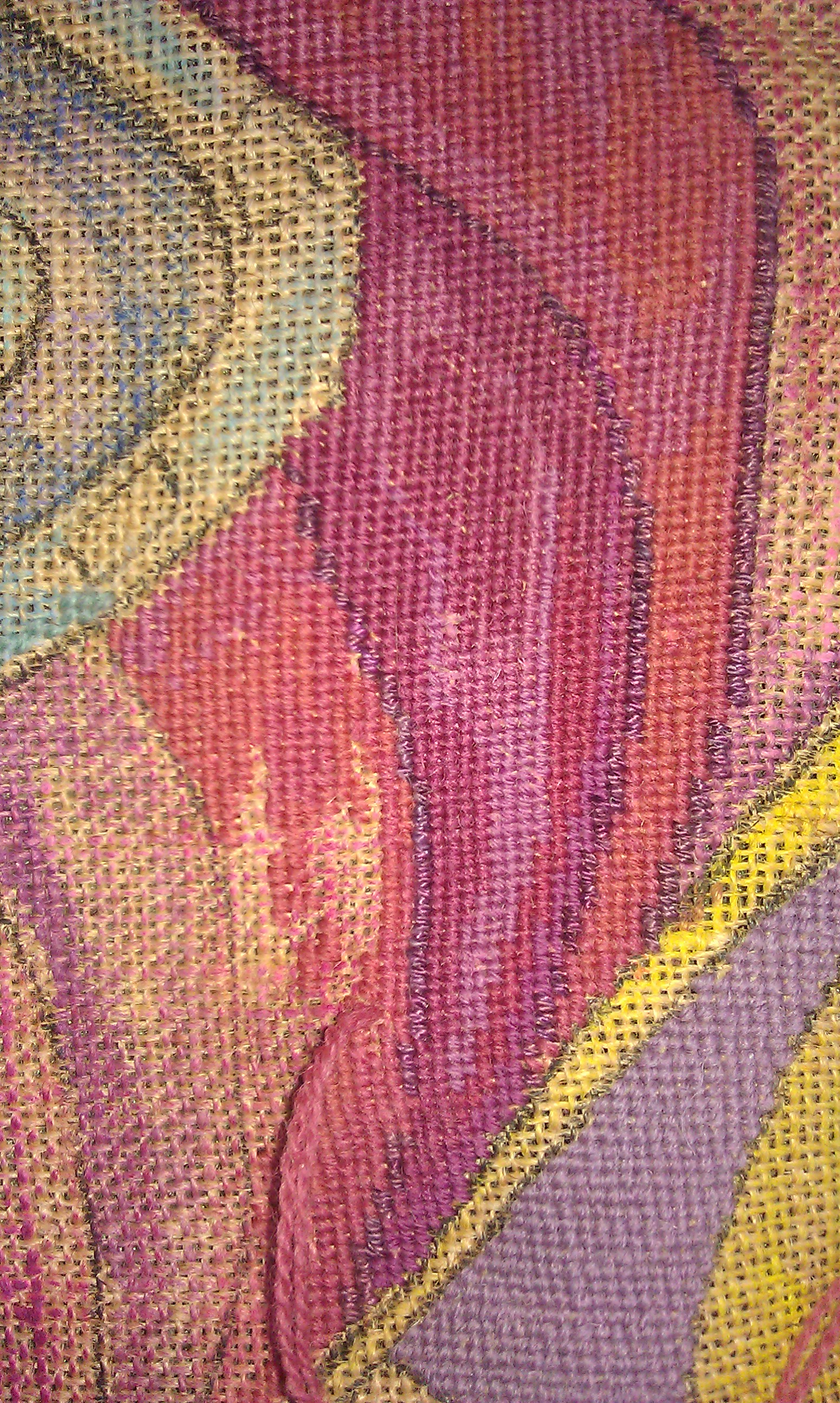
I have bought quite a lot of Appletons crewel yarns, because you get some gorgeous subtle graduations in shade, and the thickness of the yarn works well on the variable weave of the canvas.
Trying the jagged edge approach to shading
But actually doing the shading is teaching me some interesting lessons. I’m trying a variety of techniques – which range from jagged blocks of colour, to something almost approaching pointillism (although I just don’t think I have the patience to keep that up for long).
Trying out mixed colours
When I went to Canon’s Ashby earlier in the summer, I had a close look at some tapestry chairs, to see how they’d done shading in the seventeenth century – it seemed more like the graduated jagged blocks.
My biggest issue is with working at night – the time that I prefer to sew. The trouble is that although I can easily distinguish shade variations during the day, at night, under my lamp, I find it very difficult to see the real colours. It makes it quite a surprise in the morning, when I get to see it in daylight.
Happier with this bit, four different shades here, can you tell?
Ah well, on we go – it’s all a learning experience.
Well, I said I’d draw every day, and so far I’m managing to do it – but it’s a strange process. If I don’t have an idea of what I want to draw, I end up doodling – relaxing, but not exactly developing the drawing technique. But what to draw?
I have various books on the subject, most suggest that you draw your breakfast (or coffee cup, or bathroom cabinet, toothpaste tube – etc) – in other words that you draw what’s around you. OK I suppose, but it doesn’t make my spirit tingle – and I do want to get that ‘flow’ sensation.
So instead, I had a think about the sorts of things that I do like to draw, or more importantly perhaps, the things that I’d like to be able to draw.
My list is short. I like drawing (for which also read painting) trees and landscapes. I would like to be able to recreate buildings, in particular ruined castles and churches – but these I find very difficult indeed.
Well, I don’t have to be a genius to know that if I want to improve, I should practise the bits I find hard – and so (drum roll please)…
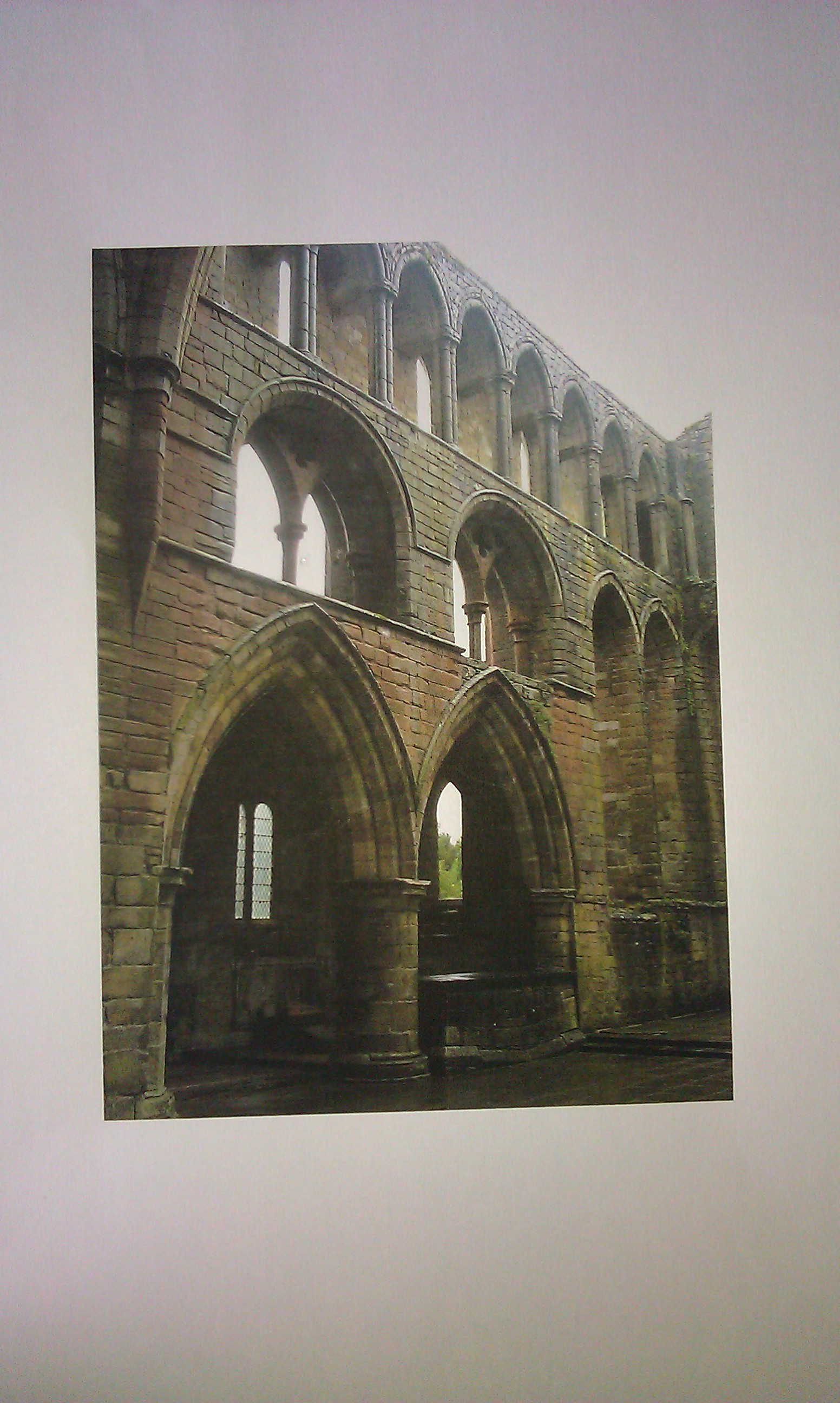
Lanercost Priory – pen and watercolour sketch.
Here is my first sketch of the inside of Lanercost Priory. We went there on holiday, on a simply horrendously wet day, and I absolutely loved it. The lady at the ticket office deserves a medal for being so enthusiastic about the site, despite the weather. She gave us a fabulous description of what to see, which even managed to inspire the daughters.
It took a lot of sketching to get this far – how on earth do you get those gothic arches to look even vaguely pointy, rather than distinctly wobbly? I think I could go mad. Anyway, this is as much as I can manage on this picture – I’m seeing arches in my sleep.
I’m using ultramarine, new gamboge and permanent magenta – my scanner doesn’t know that.
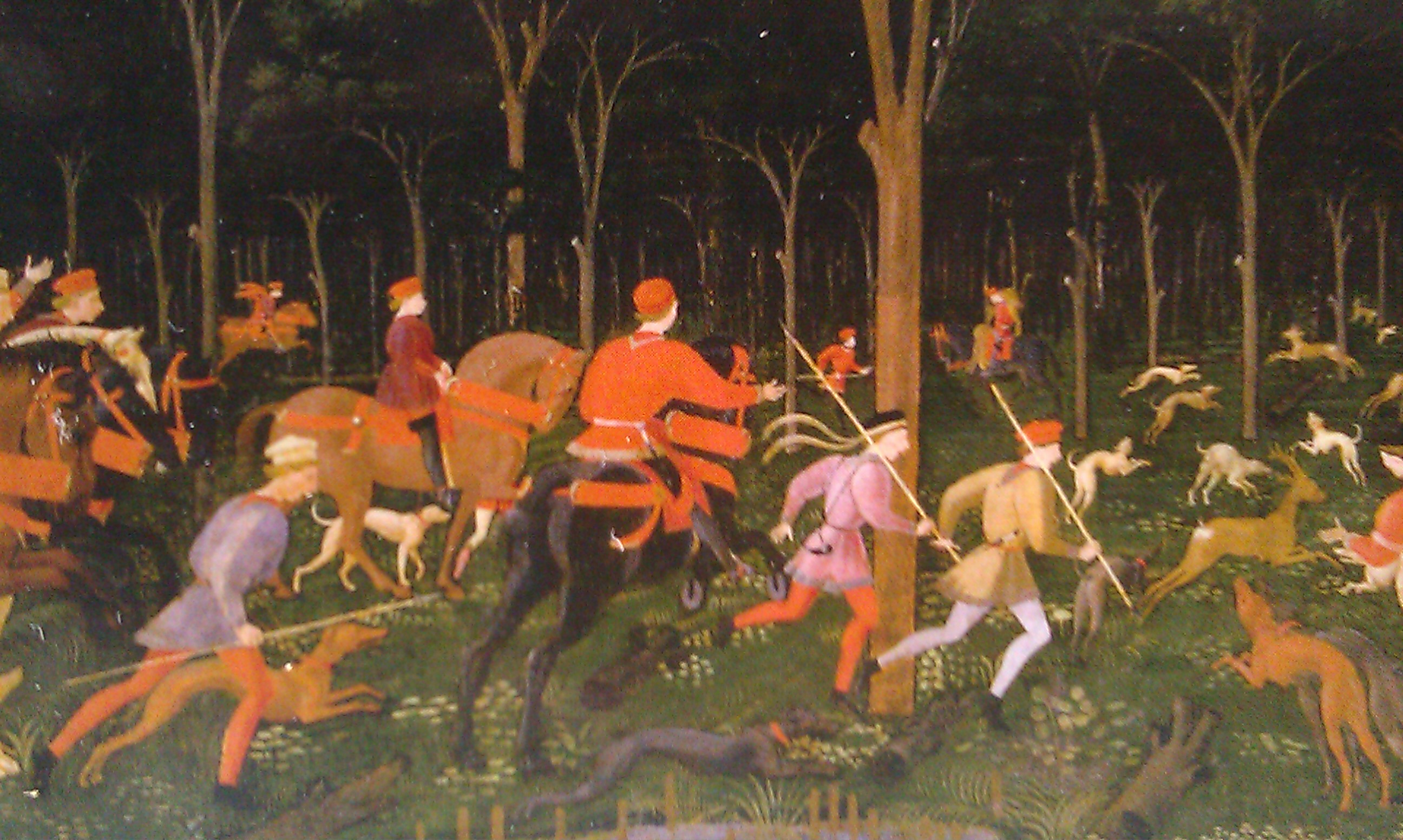
I wish I could remember when I first fell in love with Uccello’s painting, The Hunt In The Forest. It must have been some time ago, but since the babies came along, my brain seems to have developed sieve-like habits. So, you’ll just have to take it from me, I’ve liked that painting for quite a long time.
A postcard of The Hunt In The Forest
Anyway, having been lucky enough to go to Paris a couple of times in the last two years, I’ve rather got back into the habit of visiting galleries – it’s just something that wasn’t easy with two small children in tow – so it had been a few years coming.
By the way, a handy tip here if you do end up in the National Gallery with a bored eight year old – tell them to go round and count the number of naked bottoms they can find – worked a treat for me! Oh, and just so you don’t think I’m too weird, my children have now progressed to counting horses (horse mad children), but I’m sure you could adapt the principle to suit.
Having been to The Louvre, The Musee D’Orsay and various others, I was feeling well and truly cultured-up again, and then one of my favourite bloggers, Stephanie Redfern, mentioned in her blog that she’d recently seen the Uccello – The Hunt at The Ashmolean, in Oxford. Now, as we live less than an hours drive from Oxford, I was pretty stunned to find out that it was so close and I’d never realised.
So, anyway, that’s the background – this weekend, I finally got my trip to The Ashmolean and yes, there it is, on the second floor – wonderful.
detail from the painting
Now I know it probably isn’t to everyone’s taste. In a way, although it is hailed as a great and very early example of the use of perspective, it can look almost two-dimensional – even a bit cartoon like with some of the figures, especially if you only look at it from close range. But for some reason, this matters not a jot to me. The picture simply has ‘something special’ that makes me tingle.
What I hadn’t realised before, is that it was actually designed to be displayed at eye level. Having had a very good look at the picture close too, I then walked back a little and adjusted my height, to give me that eye level perspective, and guess what – suddenly, you’re drawn straight in to the darkness where the vanishing point is. And with your sight, goes your imagination.
Why are they hunting in the dark? What exactly are they hunting? Why has the man on the right suddenly pulled up his horse? Why is there a straight river on the right hand side?
I could go on, but I think perhaps that’s the beauty of the work, it triggers my imagination. I think the thing that most excites me, is imagining a fourteenth/fifteenth century painter, sitting in his studio, deciding that what he most wants to paint now, is a hunt scene in the dark. You have to admit, there aren’t that many of them around.
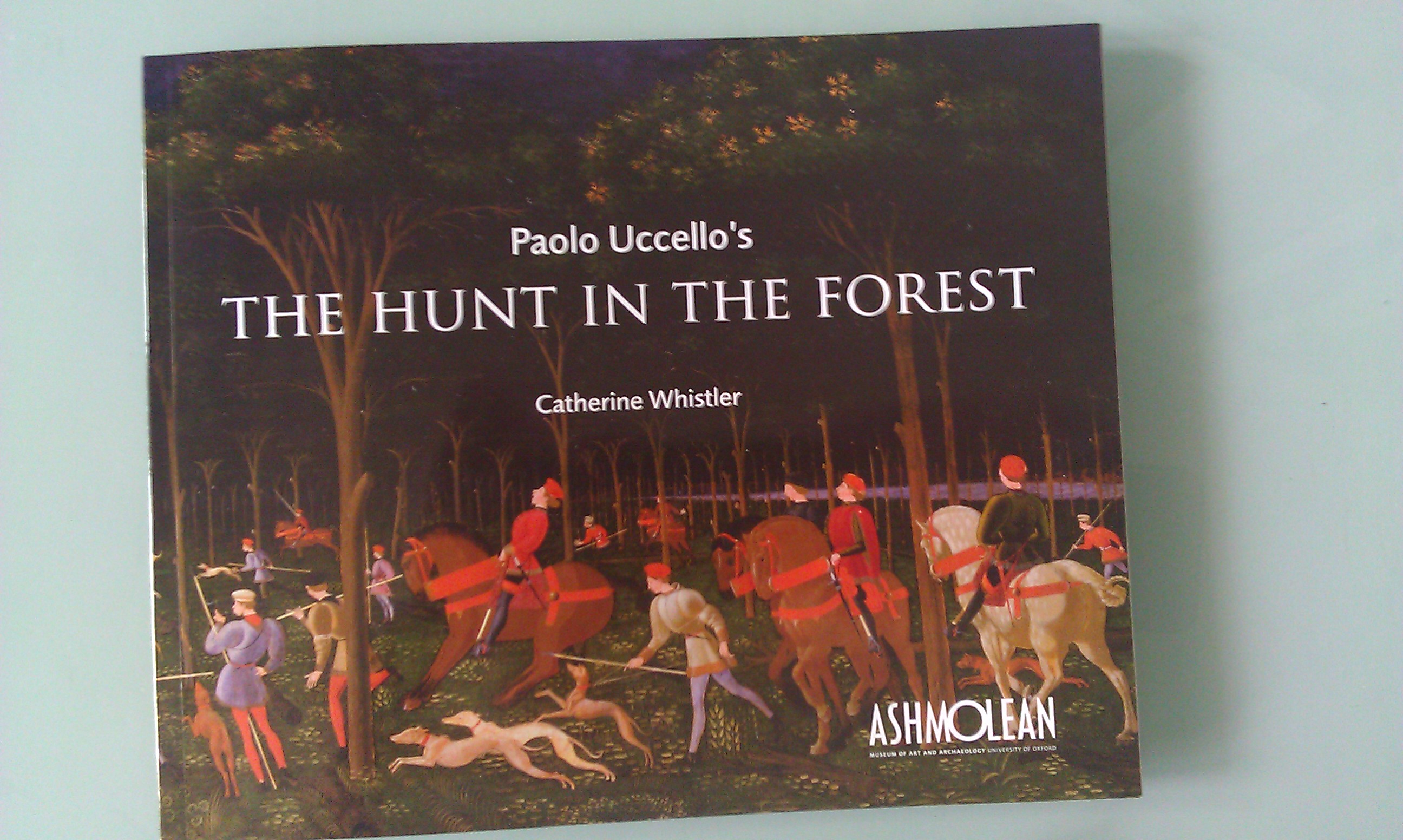
Catherine Whistler's book
I bought an interesting little book by Catherine Whistler about the picture. It’s very informative, but ultimately, I think it still leaves the viewer pondering their own response and I think that’s something Uccello might have approved.
PS: If you’re into random wafflings on various topics, you might like to see my ‘other’ blog, Mostly Motley (if you do, there’s a post about the day in Oxford – click here, if not, no problem).
I’ve been having a lot of fun over the last few days, looking at pictures of various John Hayward and Keith Day stained glass windows (inspired by my recent visit to Norwich Cathedral). I must admit that I didn’t know anything about either man before that trip, so it has been fantastic to be able to find out so much about them without having to travel miles around the country – which although I’d love to do it, simply isn’t a practical idea at the moment.
I’ve found Flickr to be a particularly good source of information and pictures, as there are obviously people with similar passions, who go out and photograph windows, then kindly upload them for us all to enjoy – thanks chaps.
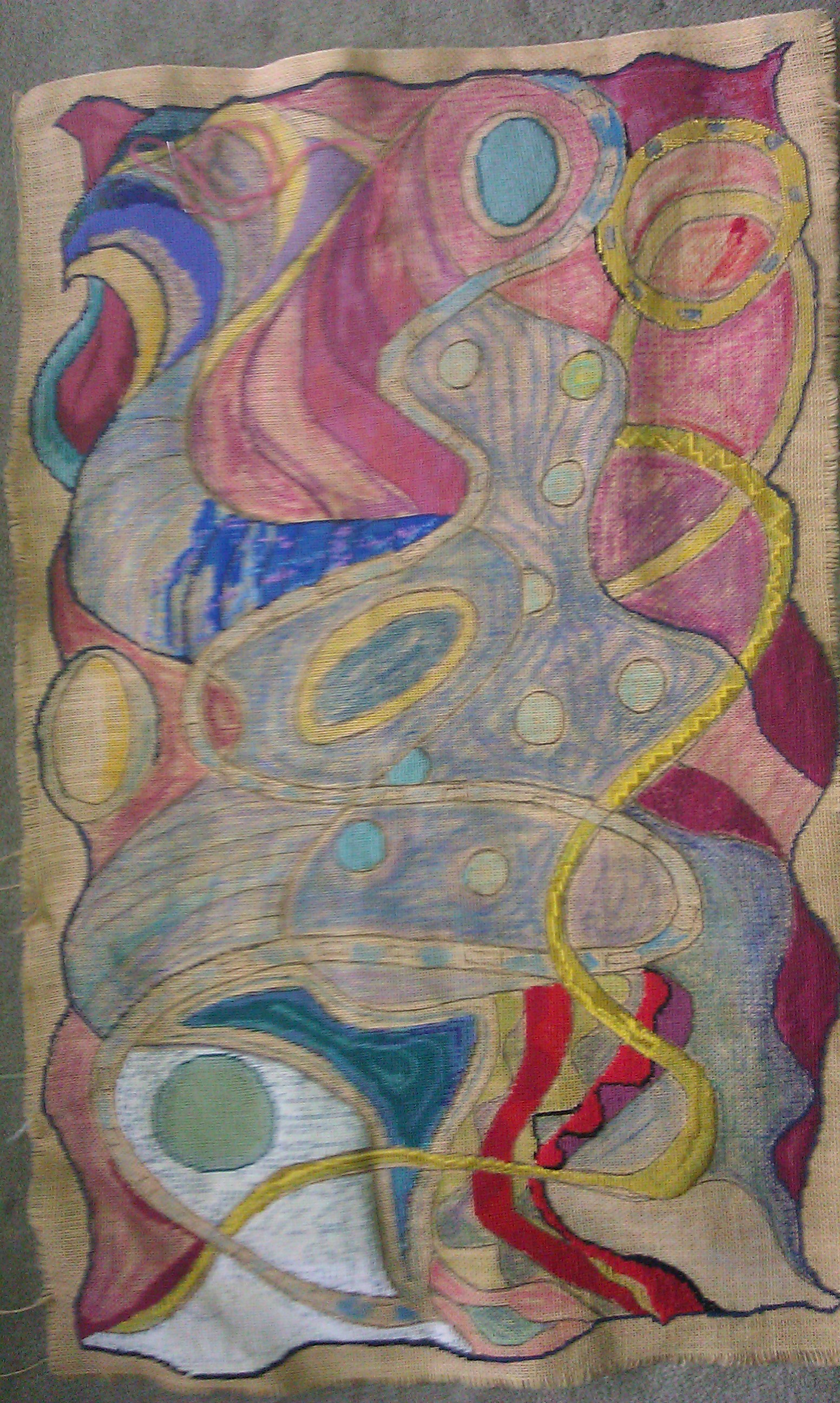
Anyway, having engrossed my self in the designs and perhaps more importantly for me, in their colours, I’ve now started to work on a new piece of tapestry – now I know that technically what I do is needlepoint or canvas work, not tapestry, but these days, so many people refer to needlepoint as tapestry, that I feel really feel more comfortable using that term, so sorry if it offends, but there you go.
The composition of something which is conceived as a whole, then broken down and worked in tiny pieces, and then finally pulled back together to present the whole once more, fascinates me. However, working with threads and canvas is very different to glass, so I’ve had to have a think about the elements that I can use and those that I need to change.
For this piece, I’ve painted my design onto the canvas – another piece of upholstery canvas, but with a tighter and more uniform weave this time. I tried using watercolours to give me variations in tone, but as they dry, they lose a lot of their intensity and in fact their colour, so instead I then went on to using pastels, which I have fixed as best I can with several applications of very smelly fixative.
I’m hoping that enough will stay in place to make working it straight forward, and that I don’t need to wear overalls when sewing, but I think I’ll be OK. I really didn’t want to use acrylics this time, because I wanted to explore a greater tonal variety than I’m usually able to manage with acrylics.
The abstract design is again one of my curvy structures. I feel very drawn to swirls, curves and circles (especially after working straight lines for so long in the meditation piece).
Next job is to start sourcing and deciding on the threads. This time I will combine metallic threads, wools and silks, as I want to give the piece more of a shine, to communicate the values of light on glass. I’m going to try and take my time with this, as my usual habit is to just dive straight in and work it out as I go along. This is fine, but occasionally, I’ve discovered a colour or texture once a piece is quite progressed, that I wish I’d used more, or in different places. Who knows, maybe I’ll manage to be fabulously organised this time, but if I’m honest, I do quite like the fact that pieces develop a life of their own as they emerge from the surface.
Well the piece of tapestry that I’ve been working on as my meditation piece is now finished.
I’ve really enjoyed the process with this piece. I think that knowing right from the start that the nature of the canvas would produce quirky and uneven stitches has helped me by removing any imperative to keep it going anywhere in particular.
All along, the feel of the canvas (a piece of upholstery canvas), has been one of my favourite things. Although I am now ready to go back to regular weave, and even probably willing to go back to a frame, the freedom to sew as the piece draped over me was very liberating.
During the working of this piece, I have experimented with Appleton threads and with a few from Renaissance Dying. The addition of these subtle colours to my yarn palette has sent my mind off into new realms. Now that I realise that it is possible to find the type of shades that I particularly want to use, I feel much happier to work on some ideas that would have been too restrictive with the yarns available to me locally.
I do wish it was possible to see the range of Appleton’s wools somewhere near to home – the nearest stockist, although helpful, only has some of the colours and keeps all of them in the stockroom, so you have to tell them the shades you want and then hope they have them.
I’ve been buying the missing shades that I wanted online, which is fine, but I really appreciate being able to see them in the flesh. I know I could buy shade cards, but even then, it’s not always easy to see how one colour might respond to another. I’ve started to dream up a little shop of my own. Who knows, maybe one day.
I’ve experimented a little here with variations and combinations of colours. Some I like and will want to do more with, others aren’t so appealing.
I’ve no idea now what to do with this piece itself. I expect for the time-being at least it will go, rolled up, into the bag I normally put everything into when it’s finished.
We’ve had an emotional few days here. I won’t trouble you with all the details, they wouldn’t really register as a tiny drop in the ocean of many people’s woes, but suffice to say, we’ve had tears aplenty. It’s at times like this, that I find myself sewing, purely for the benefit of the process itself. For me, this really is needlepoint therapy. Somehow, when I pick up my needle and start to fill in the holes in the canvass, a gradual calm comes over me, that can be difficult to find in other ways.
I’ve come to realise that for me this is a kind of meditation. At some point in the process, my mind comes in from the cold and begins to focus. This I find enormously relaxing. The downside is that when I’m in this state of, shall we call it ‘process flow’, I don’t always stick to the design ideas I started out with. This doesn’t bother me at the time that I’m doing it, but sometimes the outcomes aren’t exactly what I’d been expecting.
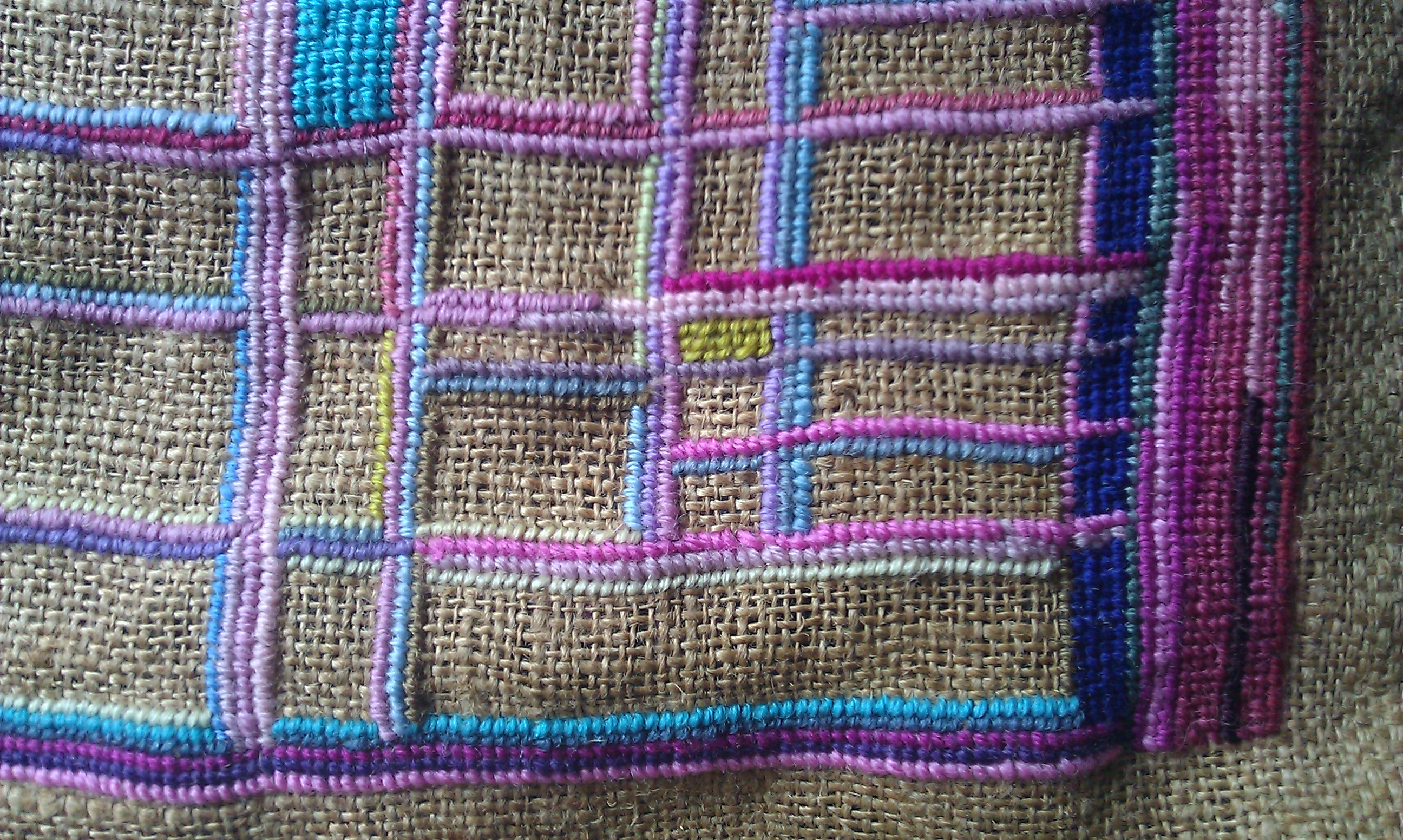
At the moment, the only really satisfying piece that I’m working on, is the one on the upholstery canvas. I find that the texture – somehow both soft and firm at the same time – is comforting to hold as I work on it, but of course as I knew it would, it bends like crazy. The design is rectangles and lines – a greatly inspired choice I hear you say, for a wonky canvas, but I don’t mind that. The thing is, it’s not really achieving the ‘look’ I’d had in my mind when I started, and I think that’s mainly because I’ve spent more time working on it while I’ve been upset, than perhaps is good for the design.
So, I think I shall make the most of it, by designating this piece my therapy canvas. It won’t matter to me whether or not anybody else likes it, what matters is that by doing it, I’ve been keeping my self together. It’s my self-healing work.
Probably not an inspired choice of canvas for a straight line design!
This morning it has rained! That’s put my in a good mood because we’d begun to imagine that we were living in a drought region, but I digress, no, this morning despite already being in quite a good mood, I decided to treat myself to some retail therapy.
I wanted to find a local shop selling interesting embroidery/tapestry wools. I don’t know about where you live, but around here, there is very little choice. There is in fact a lovely little shop in town, who carry a reasonable selection of the basic Anchor and DMC yarns, but ever since the VAT went up to 20%, they seem to have lost the plot a bit on their pricing. I know it’s probably easier for them to punch through £1 per skein, but when I can go to Hobbycraft and pay 89p, I’m afraid with the quantity of wool that I buy, I’m going to look for the cheaper option.
This is a shame, because I do like to support local businesses, but I’m not really impressed by their current pricing policy.
Of course I could buy online, and indeed, as you’d expect, this is considerably cheaper, even after postage is included. But often I’m quite intuitive about the colours and especially the textures that I want to sew with, and it just doesn’t make that easy when all you can see is a tiny patch on the screen. I like to be able to feel the colour with all my senses (I know that doesn’t make sense, but I’m right).
What I’d really like to find its someone selling individually dyed batches. I love the yarns that Stef Francis produces, but unless I’m being dense (quite possible I know), I don’t think they do wools – if you know otherwise, please let me know, as I love her silks and cottons. So is there anyone producing similarly exciting effects and shades in wools?
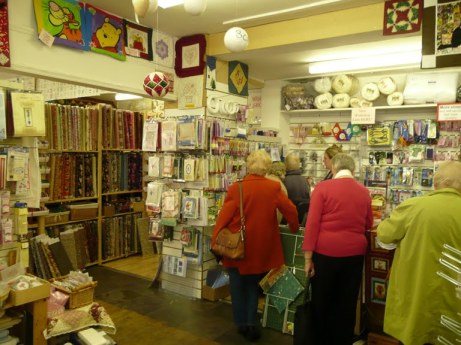
Well I haven’t exactly found anyone around here – yet, but I will keep looking. Nevertheless, this morning I discovered ‘Threads & Patches’ in Fenny Stratford, near Milton Keynes. Although I’ve lived nearby for years, this was the first time I’d been there. It’s a quilter’s paradise. The most amazing fabrics and lots of friendly people buzzing about. They have workshops there regularly so it had quite a community feel. The telephone barely stopped ringing the whole time I was there, so I’d say they were doing pretty well on the customer service front.
Photo by The Balancing Kiwi
One lovely touch, they have a ‘do-it-yourself’ tea room – what a fantastic idea!
I couldn’t find the Appleton’s threads I’d been hoping to look at, but Heather quickly obliged me, despite it obviously being quite a tricky request – why can’t Appleton’s supply display/merchandising units? Come on chaps, get your act together. Anyway, Heather was wonderful and I’ve come away the happy owner of some new colours to add to the piece I’m working on from the car boot sale.
I had a quick chat with a couple of ladies in the car park – (yes, they even have their own quite large car park) – who were clearly regulars at the shop. One lady told me that she came regularly from Luton. I told her it was my first visit and she said she thought I’d be coming back quite often now, and do you know – I think she’s right!
If I’ve managed to do it correctly, you should be able to click on the picture and go to The Balancing Kiwi’s brilliant post about the shop. If not, well try clicking here instead
You know how writers talk about getting ‘writer’s block’, they sit and look at a blank page and it almost taunts them – well I wonder if there’s such a thing as sewer’s block?
There are ideas buzzing around my head at the moment, waiting to gel into a new piece of work, but I keep looking at the roll of canvas in the corner of the room and itching to just pick it up and start stitching. It’s as if the canvas is calling to me, tempting me to put stitches in it.
I feel the need to sew, regardless of what I create, but I also know from experience that if I do start without at least having a strong colour or pattern in mind, I’ll soon become disillusioned and bored with it. And I think the canvas knows that too, it’s just testing me.
So I’m resisting, but I don’t think I can hold out much longer.
This is the first post on my new blog, Dreaming In Stitches. I’ve always been a closet stitcher, ever since I was a young woman, and over the years, whatever else I’ve been up to, I’ve always used sewing as a means of relaxation and a way to escape from the busy stuff going on around me.
For practically my whole adult life, I’ve never told anyone about my love of stitching and textile art, or indeed admitted to doing it myself, I just thought it was something I did to unwind. But recently, I’ve realised that it’s the art form in which I feel most at home, and it’s actually important to me to have pieces in progress in order to express myself.
So I suppose you could say that I’ve decided to embrace my creative streak and get involved in the world I love.
I’m no textile artist, I’m just a woman who loves to sew. Mostly I sew canvas work pieces, what some people call needlepoint and others call tapestry, but I’m a sewing tart, and can quite easily feel happy trying out all kinds of techniques.
In this blog, I’m going to talk about the things I’m doing, what’s inspiring me and who’s work I’m drooling over – amongst other things. There might well be the odd rant or ramble too.
So thanks for stopping by, I’d love it if you’d come here again, and if you feel the urge, it would be great to hear from you too.






 Dreaming In Stitches