Today is the anniversary of the Battle of Hastings – you know the one where Harold got the arrow in his eye – or maybe he didn’t. Anyway, he didn’t win, so we got to be ruled by the Normans instead.
I can’t say I’m all that hot on early Norman history, although I do love their castles, but you’ve got to have a tiny bit of respect for a victorious class who celebrate their conquest with an embroidery.
I’ve never seen the real thing, but the Bayeux Tapestry must be up there in the Top 10 of all time needlework greats.
I’d love to know how the commissioning happened. Just imagine William the Conqueror’s half-brother, Bishop Odo thinking, ‘I really should commemorate William’s amazing victory over the Saxons. I wonder what my fierce, warrior brother would like most? Umm, I know, I’ll get him an embroidery’.
Strange to say, but when I’m trying to think of ideas for my next piece of needlework, I don’t very often consider recent battles as suitable subjects. But there you are, maybe I’m missing a trick.
On my mission to draw/paint daily – today it’s been Dunstanburgh Castle.
Dunstanburgh Castle
I started off with pastels. It’s so easy to get the basic structure with pastels. But I just couldn’t get the effect I felt I wanted, so after a while, I added some acrylics. It helped, but then I lost some of the texture that I was enjoying, so I was a real devil and added some more pastels – I’m having a bit of a ball combining media.
Anyway, just to be entirely rash, I then painted in the castle in, wait for it…watercolour.
Have you been to Dunstanburgh Castle? It’s a gem. There’s a bit of a walk to get there, along the coast. The castle is there, tempting you forward, with it’s imposing gate towers and slightly wonky angles. I love it.
Well, I said I’d draw every day, and so far I’m managing to do it – but it’s a strange process. If I don’t have an idea of what I want to draw, I end up doodling – relaxing, but not exactly developing the drawing technique. But what to draw?
I have various books on the subject, most suggest that you draw your breakfast (or coffee cup, or bathroom cabinet, toothpaste tube – etc) – in other words that you draw what’s around you. OK I suppose, but it doesn’t make my spirit tingle – and I do want to get that ‘flow’ sensation.
So instead, I had a think about the sorts of things that I do like to draw, or more importantly perhaps, the things that I’d like to be able to draw.
My list is short. I like drawing (for which also read painting) trees and landscapes. I would like to be able to recreate buildings, in particular ruined castles and churches – but these I find very difficult indeed.
Well, I don’t have to be a genius to know that if I want to improve, I should practise the bits I find hard – and so (drum roll please)…
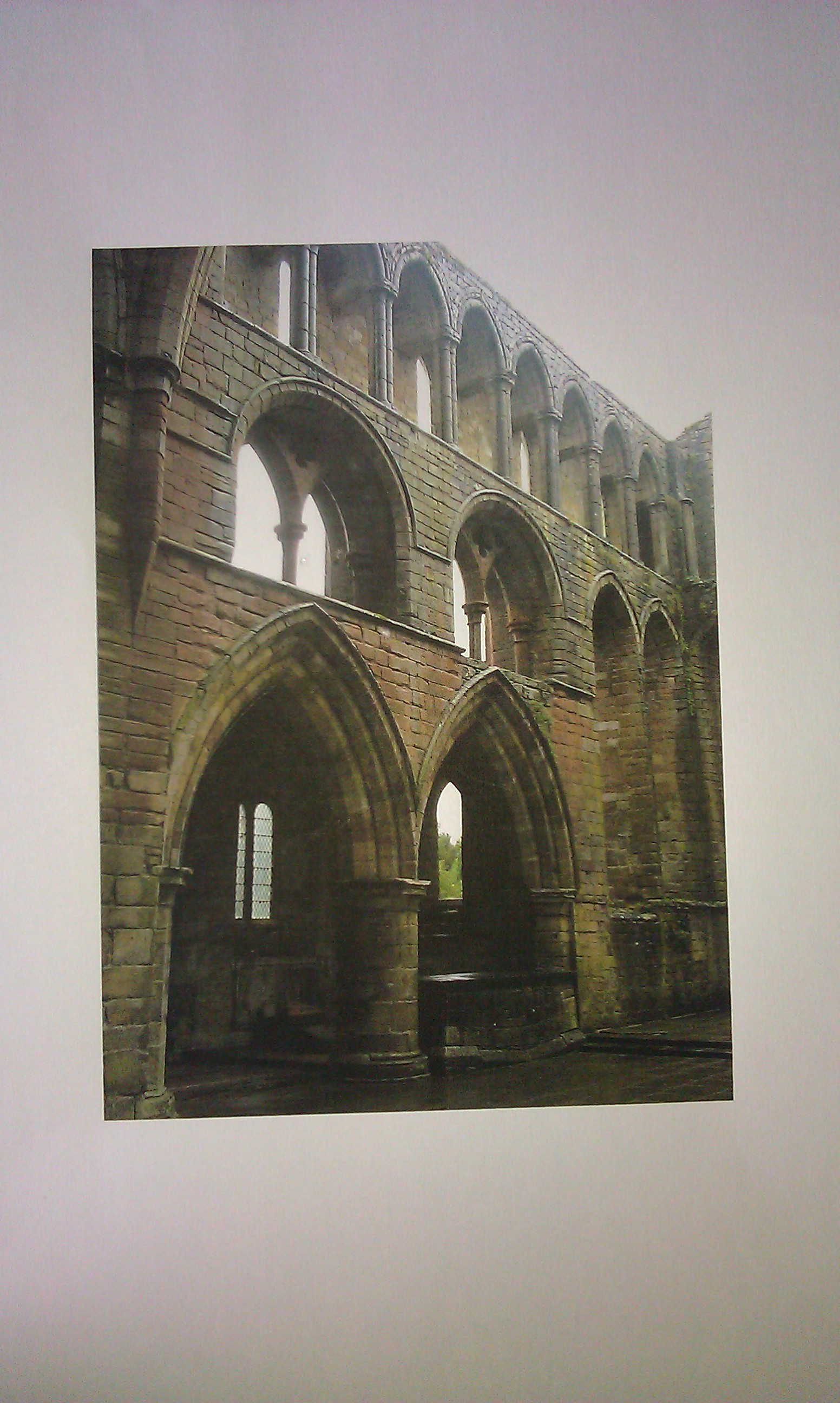
Lanercost Priory – pen and watercolour sketch.
Here is my first sketch of the inside of Lanercost Priory. We went there on holiday, on a simply horrendously wet day, and I absolutely loved it. The lady at the ticket office deserves a medal for being so enthusiastic about the site, despite the weather. She gave us a fabulous description of what to see, which even managed to inspire the daughters.
It took a lot of sketching to get this far – how on earth do you get those gothic arches to look even vaguely pointy, rather than distinctly wobbly? I think I could go mad. Anyway, this is as much as I can manage on this picture – I’m seeing arches in my sleep.
I’m using ultramarine, new gamboge and permanent magenta – my scanner doesn’t know that.
I wish I could remember when I first fell in love with Uccello’s painting, The Hunt In The Forest. It must have been some time ago, but since the babies came along, my brain seems to have developed sieve-like habits. So, you’ll just have to take it from me, I’ve liked that painting for quite a long time.
A postcard of The Hunt In The Forest
Anyway, having been lucky enough to go to Paris a couple of times in the last two years, I’ve rather got back into the habit of visiting galleries – it’s just something that wasn’t easy with two small children in tow – so it had been a few years coming.
By the way, a handy tip here if you do end up in the National Gallery with a bored eight year old – tell them to go round and count the number of naked bottoms they can find – worked a treat for me! Oh, and just so you don’t think I’m too weird, my children have now progressed to counting horses (horse mad children), but I’m sure you could adapt the principle to suit.
Having been to The Louvre, The Musee D’Orsay and various others, I was feeling well and truly cultured-up again, and then one of my favourite bloggers, Stephanie Redfern, mentioned in her blog that she’d recently seen the Uccello – The Hunt at The Ashmolean, in Oxford. Now, as we live less than an hours drive from Oxford, I was pretty stunned to find out that it was so close and I’d never realised.
So, anyway, that’s the background – this weekend, I finally got my trip to The Ashmolean and yes, there it is, on the second floor – wonderful.
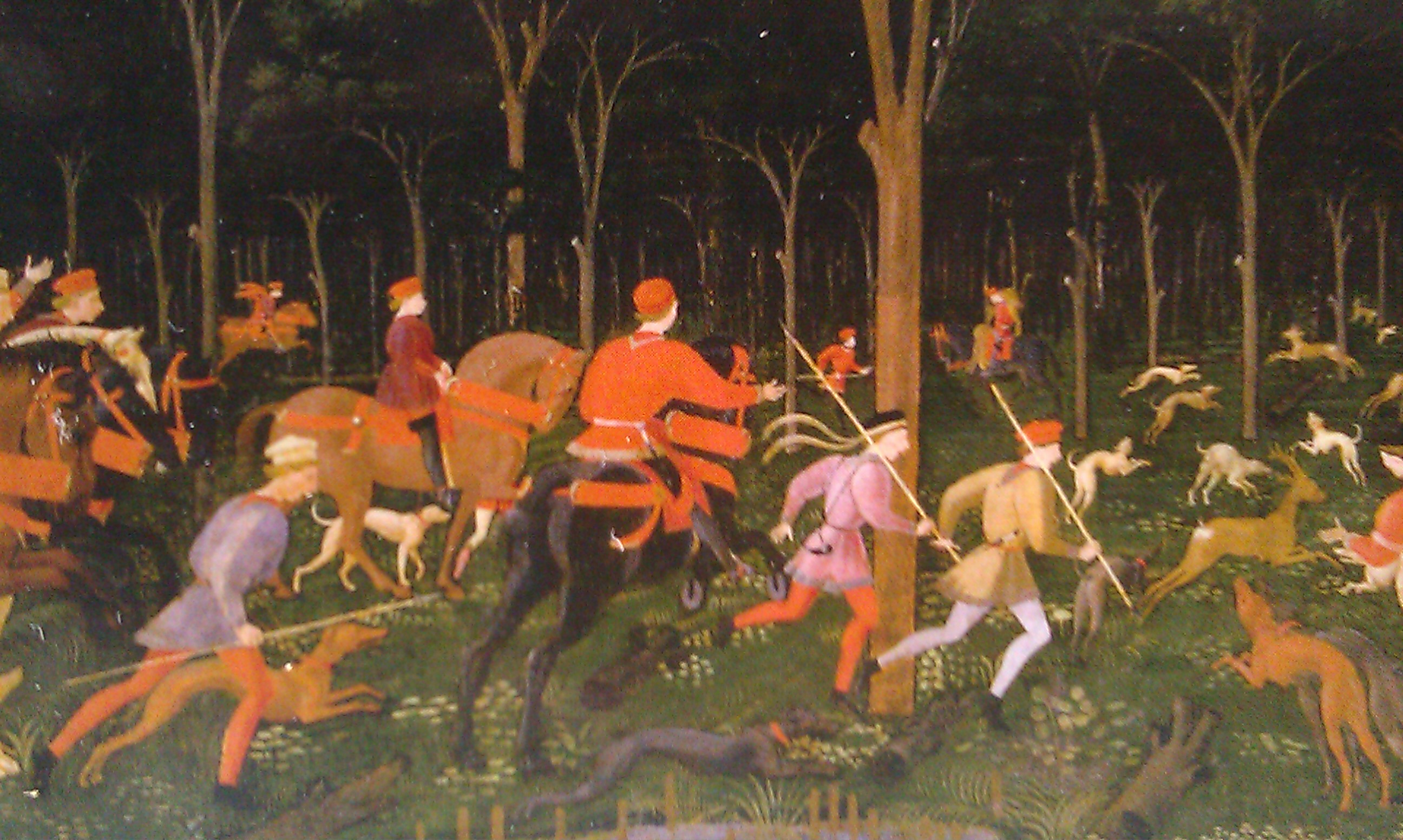
detail from the painting
Now I know it probably isn’t to everyone’s taste. In a way, although it is hailed as a great and very early example of the use of perspective, it can look almost two-dimensional – even a bit cartoon like with some of the figures, especially if you only look at it from close range. But for some reason, this matters not a jot to me. The picture simply has ‘something special’ that makes me tingle.
What I hadn’t realised before, is that it was actually designed to be displayed at eye level. Having had a very good look at the picture close too, I then walked back a little and adjusted my height, to give me that eye level perspective, and guess what – suddenly, you’re drawn straight in to the darkness where the vanishing point is. And with your sight, goes your imagination.
Why are they hunting in the dark? What exactly are they hunting? Why has the man on the right suddenly pulled up his horse? Why is there a straight river on the right hand side?
I could go on, but I think perhaps that’s the beauty of the work, it triggers my imagination. I think the thing that most excites me, is imagining a fourteenth/fifteenth century painter, sitting in his studio, deciding that what he most wants to paint now, is a hunt scene in the dark. You have to admit, there aren’t that many of them around.
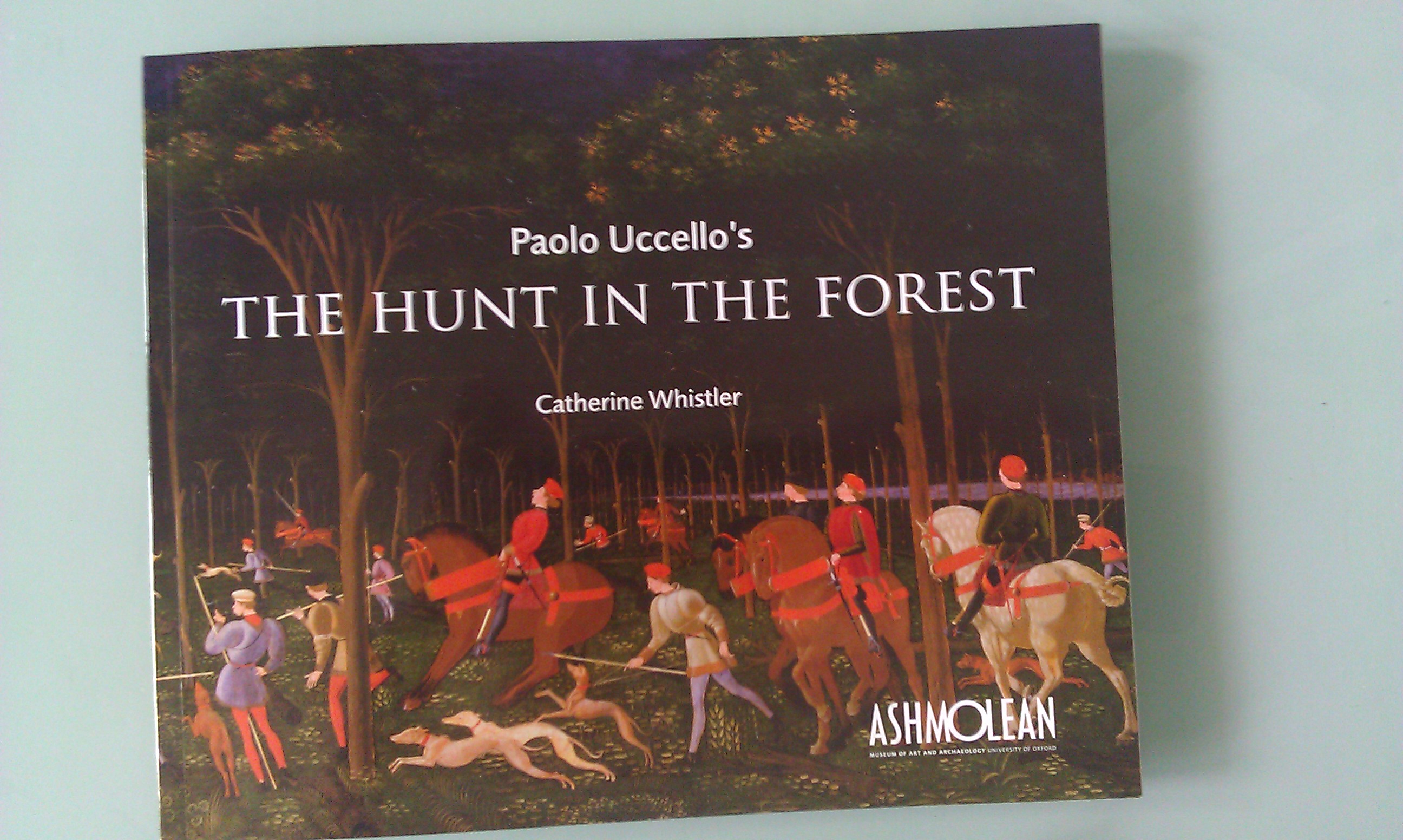
Catherine Whistler's book
I bought an interesting little book by Catherine Whistler about the picture. It’s very informative, but ultimately, I think it still leaves the viewer pondering their own response and I think that’s something Uccello might have approved.
PS: If you’re into random wafflings on various topics, you might like to see my ‘other’ blog, Mostly Motley (if you do, there’s a post about the day in Oxford – click here, if not, no problem).
At the weekend I was over in Norfolk and had the pleasure of a visit to Norwich Cathedral. It’s a fantastic building which beautifully weaves together architectural styles from the Norman period, right through to today.
There was much to appreciate in the Cathedral, but for me, the highlight was undoubtedly the stained glass and in particular the six windows in the north wall of the north transept, designed by Keith New and later complementary windows by John Hayward.
The central image of the Virgin and Child, by John Hayward
Now for a long time I’ve had a passion for stained glass, I wonder if it even dates from primary school, when we had a project to design our own, using black sugar paper and coloured tissue paper. For some reason the combination of dark leading with translucent colours and the effect of light streaming through stained glass windows, gives me an enormous thrill. I can almost sense a type of energy being created by the action of the light through the glass.
But there’s something else that has occurred to me more recently about stained glass, and that is, that I want to use the compositional methods and strong colours in my needlepoint.
This urge was given a veritable kick up the backside on Saturday, when I first encountered the John Hayward and Keith New windows. Frankly I think I could still be standing there, looking up at them, if I hadn’t been with friends (and gagging for a coffee). There is (for me at least) a mesmerizing quality to these works. The John Hayward triptych is fairly straightforward to understand, but the Keith New set had us all pondering the symbols and meaning – and that alone is significant, because neither of my friends is particularly ‘artistic’, they were simply responding to the glass as it is probably meant to be, as a mystery and a call to the spirit.
Since I’ve been home, I’ve been trying to find out more about these artists. John Hayward died in 2007, but appears to have had an extensive career, with his works being incorporated into churches across the country (and abroad). Keith New was one of the artists responsible for the stained glass at Coventry Cathedral, which having only seen once, I can remember was incredible – even somewhat overpowering.
The whole experience has really got me thinking about how to translate the composition style to the canvas. As soon as I can, I’m going to sit down with my paints and do some planning.
 I’ve never seen the real thing, but the Bayeux Tapestry must be up there in the Top 10 of all time needlework greats.



 Dreaming In Stitches